Schema–Segment Composition Computing System

Abstract
SSCCS (Schema—Segment Composition Computing System) defines computation as the deterministic projection of immutable structural primitives under dynamic constraints. The model consists of four concepts: Segments (immutable coordinate points in a possibility space), Schemes (immutable blueprints that define structural relationships between segments), Fields (mutable constraint predicates that determine which segments are admissible), and Observation (the event that evaluates a field against a scheme and produces a projection). Fields can be composed through union, intersection, and product operations, and their constraints can be encrypted or cryptographically signed for secure composition across trust boundaries.
This model differs from the von Neumann approach in three ways. First, time is a coordinate axis within a scheme rather than an implicit sequence: a scheme may declare a temporal dimension, and observations are parameterized by a time bound. Second, data movement is a compile-time property rather than a runtime cost: coordinates are not relocated between observations, and the compiler maps structural adjacency to physical adjacency in the target memory hierarchy. Third, determinism follows from the observation operator being a function of its inputs: for a fixed scheme, field, and time bound, the same projection is always produced. Non-determinism must be introduced explicitly through the resolution strategy.
The model is architecture-agnostic: the same scheme can be compiled to conventional processors (via software emulation), FPGA fabrics, or specialized hardware. A Rust-based proof of concept validates all core concepts, confirming that the abstract primitives produce deterministic results on existing silicon. An open format specification is under development [13] and is updated as the specification evolves through implementations across projects.
Philosophical Manifesto
Loops disappear into layout. Data, or state, is the shadow cast by collapsed possibility. Time is one coordinate axis among many.
A System where Structured Deployment is the Path, and Observed Synthesis is the Computation, which is not execution over time: Beneath immutable segments and schemes, observation momentarily activates the Field, precipitating the collapse of possibility and giving rise to a projection. A projection, as the residue of collapse, is transient; it constitutes what we recognize as data or state. Yet throughout this entire process, the fundamental structure itself remains untouched and unaltered.
© 2026 SSCCS Foundation — Open-source computing systems initiative building a computing model, software compiler infrastructure, and open hardware architecture.
- Whitepaper: PDF / HTML DOI: 10.5281/zenodo.18759106 via CERN/Zenodo, indexed by OpenAIRE. Licensed under CC BY-NC-ND 4.0.
- Official repository: GitHub. Authenticated via GPG: BCCB196BADF50C99. Licensed under Apache 2.0.
- Governed by the Foundational Charter and Statute of the SSCCS Foundation (in formation).
- Provenance: Human-in-Command, AI-assisted. Aligns with ISO/IEC JTC 1/SC 42 and C2PA-certified. Full intellectual responsibility with author(s).
1 Introduction
SSCCS begins as a definition of what computation is, not as a prescription for how to build it. Its primitives—Segments, Schemes, Fields, Observation—form a framework for describing structure and change, independent of any particular substrate, technology, or performance envelope.
Concrete implementations, whether on conventional silicon or on future hardware, are derivative: each is an approximate realisation that the model then corrects through Observation, the active act of revealing structure. Because Observation bridges the ideal and the instantiated, the framework remains stable across implementation generations while the realisations themselves evolve.
The primitives have been implemented as executable code—a cross-validated RISC-V simulation confirms deterministic results across independent substrates—and the same structural principle has been applied experimentally to existing open-spec silicon through ustom instruction verification via ExaVerif[1].
This reverse-validation on commercial silicon is not a target—it is a calibration. It demonstrates that the SSCCS model can be artificially instantiated within the constraints of existing architectures, serving as a proof of concept while the long-term trajectory remains native hardware where Schemes are instantiated directly rather than emulated. These empirical results ground the model in today’s silicon, but they are not projections of SSCCS-native compute.
neXus[2], the state-space engine developed alongside the reference implementation, archives every Observation as an immutable Fact—making the calibration process auditable, replayable, and composable across experiments. neXus is not part of the computational model; it is the archival implementation that preserves the model’s empirical footprint.
For decades, computation has been defined by the von Neumann model:
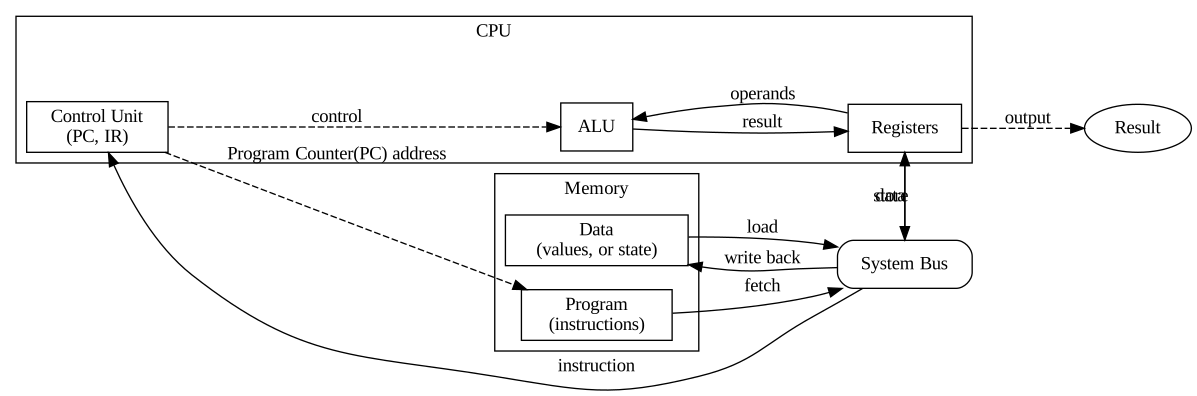
This formulation rests on several assumptions: data exists as intrinsic values in memory, programs are instruction sequences, and execution involves moving data between memory and processor across a sequential timeline. These assumptions are not fundamental laws but consequences of a specific architectural choice [3], [4], [5], [6].
SSCCS replaces procedural execution with structural observation.
SSCCS claims that data remains stationary during observation. This claim holds at two distinct levels. At the logical level, segment coordinates are not relocated between observations; a coordinate identifies a fixed point in the possibility space regardless of how many times it is observed. At the physical level, stationary data is a property of the target substrate: in software emulation, segments are encoded as memory-resident data structures and the absence of data movement is a compile-time constraint, whereas native hardware (Phase 3) eliminates physical data movement entirely by instantiating segments as stationary circuit nodes. The transition from logical to physical stationarity is the central objective of the hardware roadmap.
The model is motivated by three observations about the current hardware landscape. First, the end of Dennard scaling means that energy cost in processors is now dominated by data movement rather than arithmetic, making stationary-data models economically relevant. Second, open-source hardware ecosystems permit new computational abstractions to be prototyped on commodity FPGA boards without the capital requirements that historically restricted architectural innovation. Third, formal verification tools have advanced to the point where determinism and race-freedom claims can be mechanically verified.
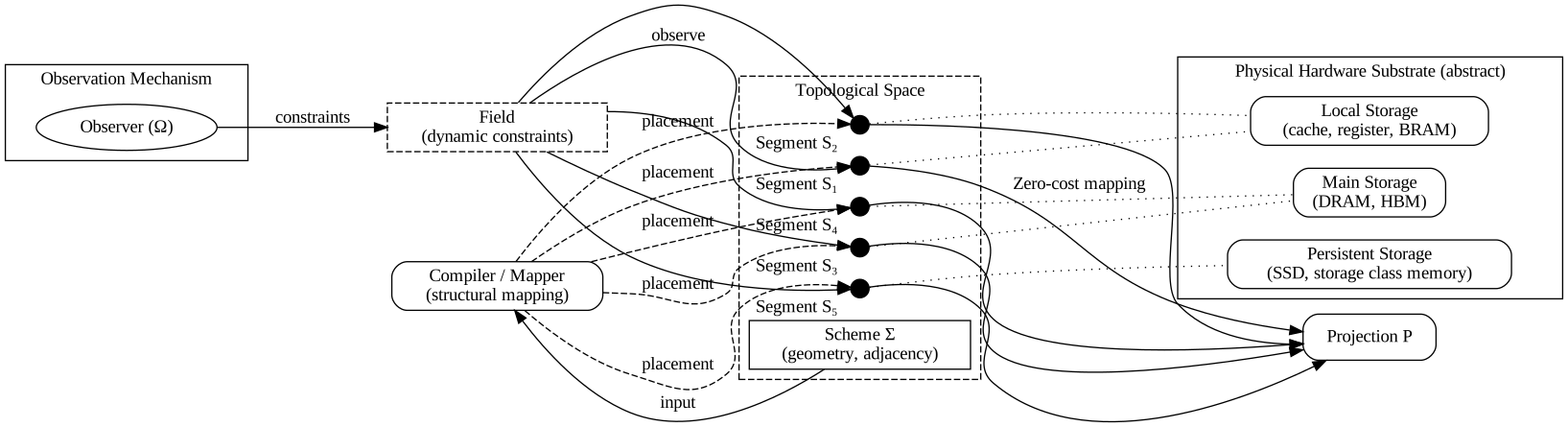
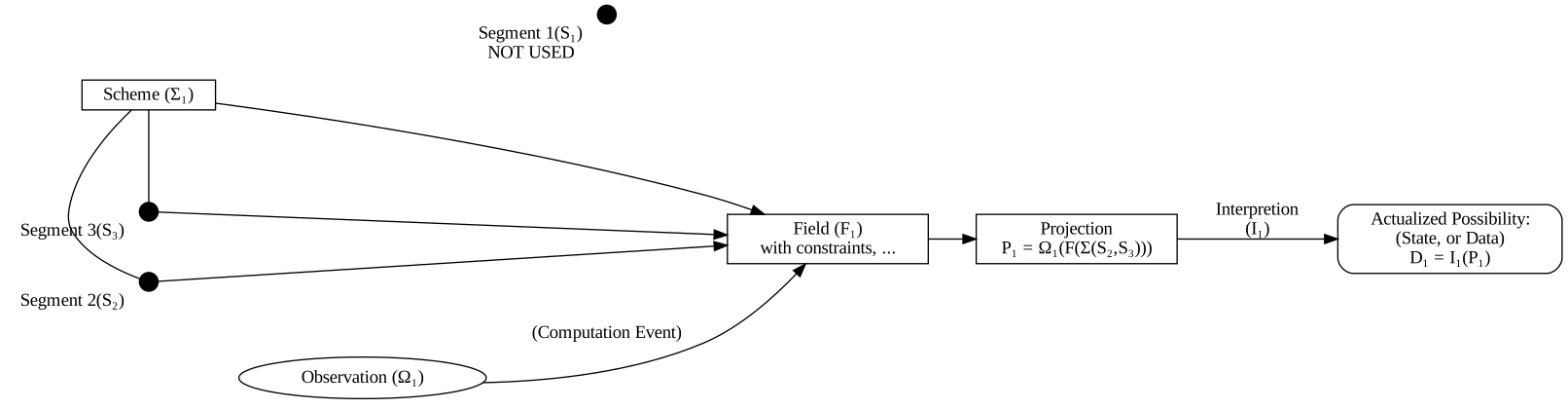
Simply put, the Field governs the observation of the Scheme and its Segments, producing a Projection that can be interpreted as data. Each layer has defined properties and relationships; together they form the complete computational model.
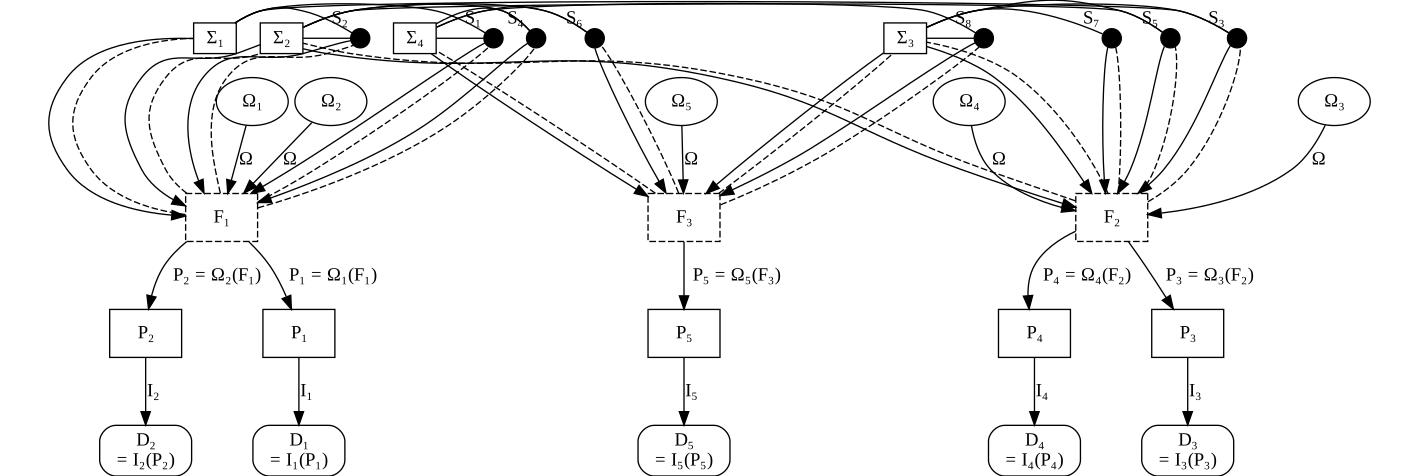
Because Segments and Schemes are immutable, observations do not require synchronization: multiple observers can evaluate the same scheme and field without locks or coordination. Data movement is a compile-time constraint rather than a runtime cost, as segment coordinates are not relocated between observations. Observation events can occur concurrently, and the resulting projections are independent. Time is a coordinate axis like any other: a scheme may declare a temporal dimension, and observations are parameterized by a time bound, but there is no implicit temporal ordering of observation events.
Two recent results in classical parallelism are structurally related to SSCCS. Erementchouk and Mazumder [7] prove that relaxed spin networks with continuous symmetry perform multiple simultaneous computations under isotonicity constraints. Kish [8] demonstrates that classical noise-based logic achieves exponential speedups for certain search problems. A detailed comparison with SSCCS primitives is provided in [22].
2 Definition of Primitives
2.1 Segment: Atomic Coordinate Existence
Let \(\mathcal{S}\) denote the set of all Segments. A Segment \(s \in \mathcal{S}\) is a tuple \((c, id)\) where \(c \in \mathbb{R}^d\) represents coordinates in a \(d\)-dimensional possibility space, and \(id = H(c)\) is a cryptographic hash providing a unique identifier.
Its properties are: Immutability (once created, a Segment cannot be modified), Statelessness (contains no values, only coordinates and identity). Because Segments contain no mutable state, they can be observed concurrently by any number of observers without synchronization. The cryptographic identity ensures that every Segment is uniquely identifiable.
2.2 Scheme: Structural Blueprint
A Scheme \(\Sigma\) is an immutable blueprint that defines the structural relationships-a geometric arrangement of Segments, not a sequence of operations, and not an implementation. A Scheme is more primitive than a hardware description language such as VHDL or Verilog: it specifies what exists and how it relates, not how it is realized. An RTL description is a compiled artifact-one possible physical encoding derived from a Scheme, not the Scheme itself. Segment relationships are spatial rather than temporal. During compilation, the compiler maps these spatial relationships directly to hardware addresses, ensuring that structurally adjacent Segments become physically adjacent. This design makes locality an inherent property of the specification, eliminating the need for runtime optimizations.
Formally, \(\Sigma = (A, R, L, O)\) where:
- \(A = \{a_1, \dots, a_k\}\) is a set of axes, each axis \(a_i = (\text{name}_i, \text{type}_i)\) with \(\text{type}_i \in \{\text{Discrete}, \text{Continuous}, \text{Cyclic}, \text{Categorical}, \text{Relational}, \text{WithUnit}\}\).
- \(R \subseteq \mathcal{S} \times \mathcal{S} \times \mathcal{T}\) is a set of structural relations, where \(\mathcal{T}\) denotes relation types (Adjacency, Hierarchy, Dependency, Equivalence, Custom).
- \(L: \mathbb{R}^d \to \mathcal{L}\) is a memory-layout mapping that assigns each coordinate a logical address.
- \(O = (\text{resolution}, \text{triggers}, \text{priority}, \text{context})\) are observation rules that govern how observations are resolved, triggered, prioritized, and contextualized.
2.2.1 Axis Types
The axis set \(A = \{a_1, \dots, a_k\}\) defines the dimensional structure of a Scheme. Each axis \(a_i = (\text{name}_i, \text{type}_i)\) where \(\text{type}_i\) belongs to a variant set that includes Discrete, Continuous, Cyclic, Categorical, Relational, and WithUnit axes. Each variant carries distinct semantic meaning (e.g., Discrete for integer coordinates, Continuous for real-valued quantities, Cyclic for periodic dimensions). These axis types are purely semantic; they guide the interpretation of coordinates and the admissible relations between Segments, but do not prescribe a particular physical representation. The compiler uses the axis types to select appropriate layout strategies and to validate structural constraints. (See 18 [18.1] for more details.)
2.2.2 Structural Relations
The relation set \(R \subseteq \mathcal{S} \times \mathcal{S} \times \mathcal{T}\) captures the topological connections between Segments. Each relation is typed according to one of five fundamental categories: Adjacency (spatial or conceptual proximity), Hierarchy (parent–child relationships), Dependency (directed influence), Equivalence (symmetric or asymmetric equivalence classes), and Custom (user-defined predicates). Each category encompasses a range of sub-types that define precise topological relationships (e.g., Euclidean and Manhattan adjacency, containment and inheritance hierarchy, data-flow and control-flow dependency). Equivalence relations denote logical equivalence; each Segment remains a distinct entity.
Relations are immutable once the Scheme is created; they define the static topology that the compiler maps onto hardware. The compiler uses the relation types to extract independent sub-graphs, optimize locality, and generate observation code that respects the structural dependencies. (See 18 [18.2] for more details.)
2.2.3 Memory-Layout Abstraction
The mapping \(L: \mathbb{R}^d \to \mathcal{L}\) assigns each coordinate a logical address, decoupling the Scheme’s geometric structure from the physical memory hierarchy. The MemoryLayout is specified by a layout_type and a mapping function. Available layout types include Linear, Row-Major, Column-Major, Space-Filling Curve, Hierarchical, Graph-Based, and Custom layouts, each mapping coordinates to logical addresses in a distinct manner.
The logical address \(\ell = L(c)\) consists of a space identifier and an offset within that space. It serves as an intermediate representation that the compiler later translates to physical addresses according to the target hardware’s memory hierarchy. The choice of layout type is a critical optimization: it determines how structurally adjacent Segments are placed in physical memory, thereby minimizing data movement during observation. (See 18 [18.3] for more details.)
2.2.4 Observation Rules
The observation rules \(O = (\text{resolution}, \text{triggers}, \text{priority}, \text{context})\) govern how the observation operator \(\Omega\) is applied to the Scheme. Resolution strategies (deterministic, probabilistic, energy minimization, entropy maximization, external), triggers (on-demand, periodic, threshold, structural change, dependency satisfied, external event), priority levels, and context meta-constraints together enable fine-grained control over the observation process. For deterministic reproducibility—a core principle of SSCCS—a deterministic resolution strategy must be used; non-deterministic strategies are permitted only when strict reproducibility is not required.
Observation rules are part of the Scheme’s immutable specification; they enable fine-grained control over the observation process, allowing the designer to trade off determinism against other desiderata. (See 18 [18.4] for more details.)
2.2.5 Pre-defined Scheme Templates
SSCCS provides a set of canonical Scheme templates that capture common topological patterns, such as regular grids, integer lines, and arbitrary graphs. These templates are idiomatic combinations of axis, relation, and layout abstractions, serving as starting points for developers to construct custom Schemes. Detailed descriptions of each template are provided in the [19].
2.3 Field: Dynamic Constraint Substrate
The Field \(F\) is the only mutable layer, but it does not store values. Instead, it stores admissibility conditions that dynamically constrain which configurations of Segments are possible at any given time. Formally, \(F = (C, T)\) where:
- \(C: \mathcal{S} \to \mathbb{B}\) is a constraint predicate. It is the conjunction of individual constraints \(c_i\):
\[ C(s) = \bigwedge_{i=1}^{n} c_i(s). \]
Adding a constraint produces a monotonic shrinking of the admissible set: \(C'(s) = C(s) \land c_{n+1}(s)\) satisfies \(C'(s) \implies C(s)\).
- \(T: \mathcal{S} \times \mathcal{S} \to \mathbb{R}\) is a transition matrix that assigns weights to possible transitions between Segments.
Mutating \(F\) changes which configurations are possible, but does not modify any Segment.
2.3.1 Constraint Types
The constraint predicate \(C(s)\) of a Field can express a wide variety of admissibility conditions. To aid systematic design, constraints can be categorized into five fundamental types based on their mathematical structure:
Dimensional constraints restrict the coordinate values of a Segment along one or more axes. They are expressed as inequalities or membership in intervals, e.g., \(x \in [a,b]\) or \(\|c\| \leq r\). Dimensional constraints are the simplest form of geometric filtering and correspond to traditional bounding‑box or range queries.
Topological constraints govern the relational structure between Segments. While the Scheme defines static adjacency and dependency relations, a Field can impose dynamic topological requirements—for example, that two Segments must be adjacent, or that a path of a certain length must exist between them. Topological constraints are naturally expressed using the relation set \(R\) of the Scheme and can be seen as predicates over the Scheme’s graph.
Algebraic constraints involve equations or inequalities that combine coordinate values with arithmetic operations. Examples include linear equalities \(a_1x_1 + \dots + a_kx_k = b\), quadratic forms \(c^TQc \leq \epsilon\), or more general polynomial constraints. Algebraic constraints enable rich geometric shapes (spheres, ellipsoids, hyperplanes) and are essential for modelling physical laws.
Logical constraints are Boolean combinations of other constraints, realized through Field composition. The union (\(\cup\)), intersection (\(\cap\)), and product (\(\times\)) operations allow arbitrary logical connectives (AND, OR, NOT) to be applied across multiple Fields. Logical constraints provide the compositional power needed to build complex admissibility conditions from simpler ones.
Physical constraints encode real‑world limitations such as energy budgets, timing deadlines, or thermal thresholds. These quantities can be represented as additional coordinate axes (e.g., an energy axis \(e\), a latency axis \(\tau\)) within the Segment’s possibility space, or as auxiliary dimensions defined in the Scheme’s axis set. Physical constraints are then expressed as inequalities on those axes, e.g., \(e \leq E_{\text{max}}\), and can influence the transition matrix \(T\) to reflect preferences among admissible Segments.
This taxonomy is not mutually exclusive; a single Field may contain constraints of several types. The classification serves as a conceptual tool for designers, helping them choose the appropriate constraint representation and composition strategy for a given problem. In practice, the compiler may exploit the structural properties of each type to optimize observation code—for instance, dimensional constraints can be evaluated via range‑check circuits, while algebraic constraints may require dedicated arithmetic units. (See [18.1] for a detailed listing of axis types and [18.2] for relation categories.)
2.3.2 Composition
Field composition refers to the combination of two or more Fields to produce a new Field whose constraints and transition matrices are derived from the constituent Fields. Given Fields \(F_1 = (C_1, T_1)\) and \(F_2 = (C_2, T_2)\), a composition operator \(\odot\) yields \(F = F_1 \odot F_2 = (C, T)\) where \(C\) and \(T\) are defined according to the semantics of the composition.
Fields support three fundamental binary operations:
Union (\(\cup\)): \(F = F_1 \cup F_2\) with \(C(s) = C_1(s) \lor C_2(s)\) and \(T(s_1, s_2) = \max(T_1(s_1, s_2), T_2(s_1, s_2))\). The union broadens the admissible set, allowing any Segment admissible in either Field. Observation under the union yields projections that satisfy at least one of the original constraints. Because the transition matrix entries can be interpreted as preference weights, taking the maximum corresponds to choosing the higher preference when either Field admits the transition.
Intersection (\(\cap\)): \(F = F_1 \cap F_2\) with \(C(s) = C_1(s) \land C_2(s)\) and \(T(s_1, s_2) = \min(T_1(s_1, s_2), T_2(s_1, s_2))\). Intersection restricts admissibility to Segments that satisfy both constraints, producing a more constrained projection. Using the minimum of the preference weights reflects that a transition is only as strong as its weaker constituent.
Product (\(\times\)): \(F = F_1 \times F_2\) where the resulting Field operates over the Cartesian product of Segment sets, with constraints and transitions defined componentwise: \(C((s_1, s_2)) = C_1(s_1) \land C_2(s_2)\) and \(T((s_1, s_2), (s'_1, s'_2)) = T_1(s_1, s'_1) \cdot T_2(s_2, s'_2)\). This product enables independent parallel observation of distinct subspaces—for example, when the two Fields govern disjoint coordinate axes (e.g., time and frequency). The overall projection becomes an ordered pair of the individual projections.
Implementing these operations efficiently requires careful handling of constraint representations. Union and intersection can be realized via Boolean satisfiability (SAT) solvers or constraint-propagation engines; the product operation, which expands the state space, may benefit from symbolic techniques (e.g., binary decision diagrams) to avoid exponential blow-up. In hardware, dedicated units for max/min and multiplication can accelerate transition-matrix computations.
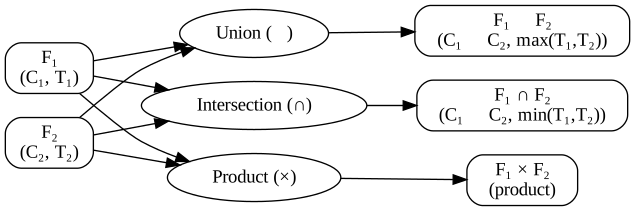
Beyond binary operations, Fields can also be composed in three higher-level ways: hierarchical, sequential, and parallel.
Hierarchical composition: Fields can be nested to create hierarchical structures. A parent Field \(F_{\text{parent}}\) may contain child Fields \(F_{\text{child}}\) that govern subspaces of the coordinate space. The effective constraints are the conjunction of parent and child constraints, enabling modular refinement of governance. This nesting naturally aligns with modular hardware design (e.g., nested processing units) but adds depth to constraint evaluation, potentially increasing latency.
Parallel composition: Independent Fields may observe the same Segment simultaneously. Because Segments are immutable, concurrent observations do not interfere. The resulting projections are independent and can be combined via product or other combinators. Parallel composition embodies the inherent concurrency of SSCCS: multiple observers can safely read the same coordinate space without synchronization.
Sequential composition (Extension): Fields can be applied in a temporal order: first \(F_A\), then \(F_B\). Because SSCCS treats time as one coordinate among many, sequential composition can be understood as applying Fields over adjacent time intervals. One interpretation models functional composition of constraint predicates: \(C(s) = C_B(C_A(s))\) (where each predicate is viewed as a selector of admissible states) and convolution of transition matrices: \(T(s_1, s_2) = \sum_{s'} T_A(s_1, s') \cdot T_B(s', s_2)\). This models processes where constraints evolve over time, such as multi-stage pipelines or state machines. Sequential composition requires ordering guarantees that can be enforced through hardware scheduling or explicit synchronization primitives. It can be presented as an optional extension; the core model does not depend on global sequentiality.
The immutability of Segments eliminates data-race hazards, making parallel composition naturally scalable across many cores. However, coordinating the distribution of Fields and collecting projections may introduce overhead. Hardware support for atomic broadcast of Segment addresses and gather-scatter of projection results can mitigate this overhead, enabling efficient many-observer systems.
2.3.3 Logical and Binary‑Level Composition Protocols
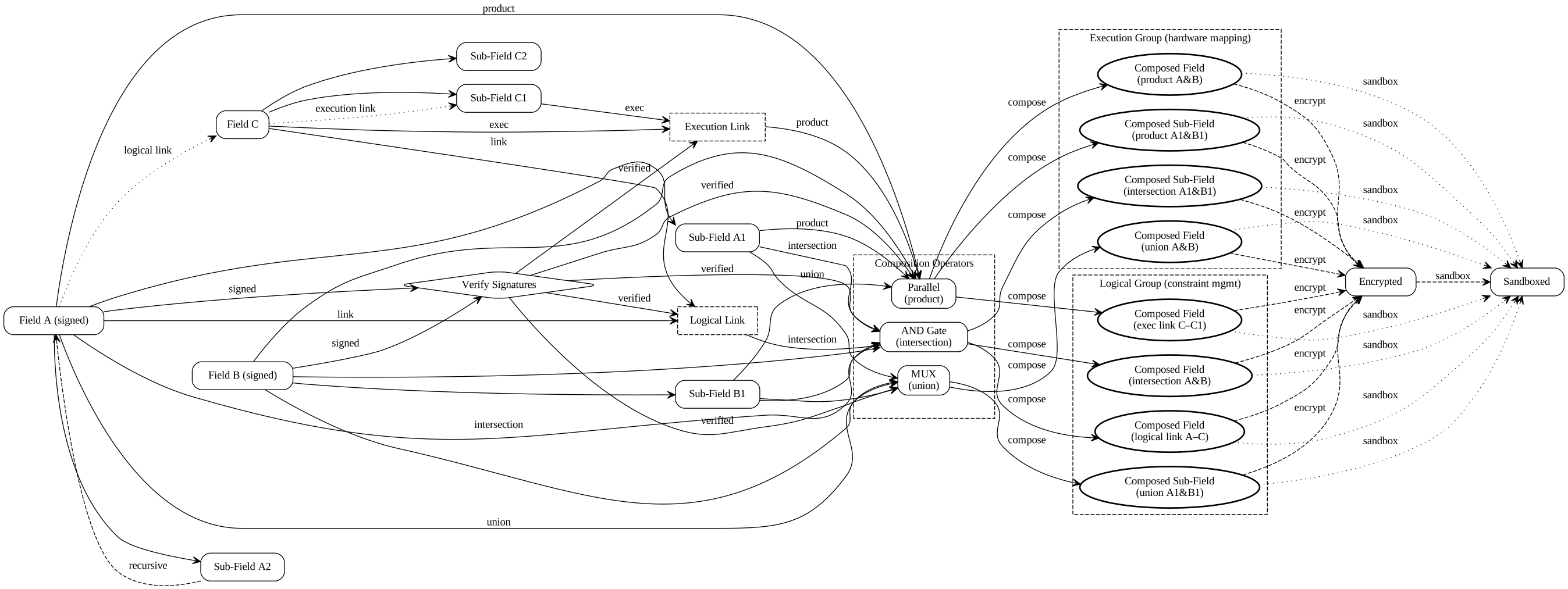
Beyond purely logical combination, Field composition also serves as a communication primitive in the physical runtime. Fields can be encrypted, signed, or sandboxed at the binary level, enabling secure composition across trust boundaries. This dual nature—logical composition and physical communication unit—makes Fields a unifying abstraction that bridges the logical specification and the hardware-executable representation.
Fields can be grouped into logical units (for constraint management) and execution units (for hardware mapping), as illustrated in the diagram below. The recursive edge in the diagram shows that a Field can contain itself, enabling self-similar composition—a key property of the ribosome-like model where the same structural pattern repeats at different scales.
In safety-critical and extreme-environment deployments (e.g., space computing, autonomous systems), Fields can be compiled into cryptographically signed, sandboxed binaries. This dual nature enables post-deployment policy updates, adaptive constraint reconfiguration, and verifiable execution without modifying underlying silicon. By treating fault-tolerance logic as dynamically composable Fields, SSCCS transcends static hardware hardening, allowing systems to evolve resilience strategies in response to changing environmental conditions or mission phases.
Hand‑off mechanisms. Fields support secure composition across trust boundaries through cryptographic signing and encryption. A signed Field carries a digital signature that guarantees its integrity and origin; the runtime verifies the signature before allowing composition. An encrypted Field can only be observed by holders of the corresponding decryption key, enabling confidential computation. Sandboxed Fields execute within isolated hardware domains, preventing side‑channel attacks and ensuring fault containment.
Hardware mapping of composed Fields. When Fields are composed, the compiler maps the resulting logical constraints onto physical hardware units. For example, a union of two Fields may be realized by a multiplexer that selects the admissible Segments from either constituent Field. Intersection can be implemented as a logical AND gate across constraint predicates. Product composition maps to parallel execution units that operate on independent coordinate subspaces. The compiler generates hardware‑specific control logic that respects the composition semantics while preserving determinism.
Composition with cryptographic signatures. For example, consider two Fields \(F_A\) and \(F_B\), each signed by different authorities. The runtime verifies both signatures before allowing their intersection \(F_A \cap F_B\). This ensures that only authorized constraints are combined, a property crucial for multi‑party secure computation.
The recursive edge in the diagram illustrates that Fields can contain themselves, enabling self‑similar composition—a property reminiscent of biological ribosomes that translate code into structure and then reuse that structure as new code. This compositional recursion underpins SSCCS’s ability to define adaptive, verifiable computation across scales, a capability that proves especially valuable in safety‑critical and extreme environments. A detailed worked example of constraint intersection is provided in [17]; the corresponding framework for fault‑tolerant computing in extreme environments is described in [16].
2.4 Observation and Projection
The observation operator \(\Omega\) is the single active event that produces a projection from a Scheme and a Field:
\[ P = \Omega(\Sigma, F). \]
Let \(\mathcal{A}(\Sigma, F) = \{ s \in \mathcal{S} \mid C(s) = \text{true} \}\) be the set of Segments admissible under the Field’s constraints. The observation operator selects a projection \(P\) according to the resolution strategy specified in \(O\). For a given segment \(s\), observation proceeds in two stages. First, \(C(s)\) is evaluated: if false, no projection is produced. Second, for admissible segments, the projector \(\pi\) encodes the semantic interpretation:
\[ \Omega(s) = \begin{cases} \pi(s, F) & \text{if } C(s) = \text{true}, \\ \bot & \text{otherwise.} \end{cases} \]
The observation operator is therefore a partial function over \(\mathcal{S}\): it is defined only for segments in \(\mathcal{A}(\Sigma, F)\). Outside the admissible set, no projection exists.
If the resolution strategy is deterministic, \(\Omega\) is a function of its arguments: for a fixed scheme, field, and time bound, \(\Omega\) always produces the same projection. If the strategy is probabilistic, \(\Omega\) samples from a distribution defined by the transition weights \(T\). No data is moved during observation; segments remain in place.
The set of possible next segments from a given segment \(s\) is determined by two sources: the projector’s adjacency relation \(R_\pi\) and the Field’s transition matrix \(T\), intersected with the admissible set:
\[ \text{Next}(s) = \{ s' \in \mathcal{A}(\Sigma, F) \mid R_\pi(s, s') \lor T(s, s') > 0 \}. \]
The projector defines structural adjacency (nearest neighbours, arithmetic successors); the Field defines dynamic preferences. Both are constrained by admissibility \(C(s')\).
2.5 Field Evolution and Observation Transition
Fields are mutable by design (see §3.3). An update rule consists of a trigger and a transformation that modifies the Field’s constraint predicate \(C\) and transition matrix \(T\):
\[ F' = \text{update}(F, \text{trigger}, \text{context}). \]
When a Field updates, any previously computed projection becomes stale; a subsequent observation reflects the new Field state.
The determinism of an update depends on its trigger type. A temporal trigger is deterministic if its time source is monotonic and reproducible (a fixed-step clock or logical epoch counter); it is non-deterministic if derived from wall-clock time. A dependency trigger is deterministic if the update order is fixed. An event trigger is deterministic only if the event source itself is deterministic. Observed and composite triggers inherit determinism from their constituents.
The trigger types are summarised below; formal semantics and determinism properties are provided in [20].
| Trigger Type | Description | Deterministic |
|---|---|---|
| Temporal | After a duration along the Scheme’s time axis (if present) | Yes (fixed rate) |
| Event | External signal (hardware interrupt, network message) | No (unless source is deterministic) |
| Observed | A projection satisfies a predicate immediately after observation | Depends on predicate |
| Dependency | Another Field updates | Yes (if order is fixed) |
| Composite | Logical combination (AND, OR, sequencing) | Depends on components |
When a Field that participates in a composition (union, intersection, product) is updated, the composite Field is implicitly updated according to the composition rule (e.g., \(F_A \cap F_B\) becomes \(F_A' \cap F_B\)). The runtime tracks versions of constituent Fields and recomposes lazily.
Observation results are ephemeral (see §3.4). Caching with versioning is an implementation optimisation—it does not change semantics. The runtime ensures that each observation returns a result consistent with the current Field state; stale projections are transparently recomputed. The diagram below illustrates the dynamic observation cycle.

Examples:
- Temporal evolution, deterministic: A Scheme with a time axis. Field \(F\) admits \(x \in [0,10]\). Rule:
after(10s)expands the interval by 2. After 10 seconds, a new observation yields \(x \in [0,12]\). - Event-driven, non-deterministic: Temperature sensor Scheme. Field \(F_0\) admits values > 30 (alarm). An external fire-suppression event triggers update to \(F_1\) (threshold > 50). A later observation gives a refined alarm set.
Detailed trigger semantics, versioning implementation notes, and compiler/runtime considerations are provided in [20].
2.6 Structural Isolation
Security properties emerge from the immutable structure rather than being added features. Since Segments cannot be modified, concurrent observations are naturally isolated. Formally, for any two disjoint sets of Segments \(S_1\) and \(S_2\),
\[ \Omega(S_1 \cup S_2, F) = \Omega(S_1, F) \times \Omega(S_2, F), \]
where \(\times\) denotes independent composition of projections. Every Segment and Scheme has a unique cryptographic hash, enabling identity-based boundaries where computations can only access Segments for which they hold valid references. This provides inherent structural isolation against interference without requiring additional security mechanisms.
2.7 Relationship with Traditional Concepts
| Traditional Concept | SSCCS Counterpart | Shift |
|---|---|---|
| Instruction fetch | Not applicable | No imperative control flow |
| Operand load | Segment coordinates | Stationary data move |
| Result store | Projection (ephemeral) | Results are events, not states |
| Cache line fill | Structural layout | Locality from geometry |
| Lock acquisition | Immutability | No shared mutable state |
| Program counter | Coordinate dimension | Time as coordinate |
| Algorithm | Geometry | Structure determines observation |
2.8 Formal Properties
2.8.1 Energy Model
A formal energy model for SSCCS can be expressed as:
\[ E_{\text{total}} = E_{\text{obs}} \cdot N_{\text{obs}} + E_{\text{update}} \cdot N_{\text{update}}, \]
where \(E_{\text{obs}}\) is the energy required to perform a single observation, \(E_{\text{update}}\) is the energy required to mutate the Field, \(N_{\text{obs}}\) is the number of observations, and \(N_{\text{update}}\) is the number of field updates. There is no term for moving data between memory and processor, because Segments are stationary [6].
2.8.2 Immutability and Concurrency
Because Segments are immutable, any number of observations can be performed simultaneously without interference. This property follows directly from the absence of shared mutable state: since Segments cannot be modified, observations on disjoint sets have no side-effects that could affect each other. Consequently, SSCCS enables inherent parallelism without any programmer effort or runtime synchronisation.
See the Structural Isolation section for a formal statement.
2.8.3 Time as a Coordinate
Time is treated as one coordinate axis among many. When a Scheme declares a time axis \(T \subseteq \mathbb{R}\), observations are parameterized by a time bound \(t\):
\[ P = \Omega(\Sigma, F, t), \]
where only facts recorded at \(t' \leq t\) are admissible. The axis \(T\) may be continuous (\(T = \mathbb{R}\)) or discrete (\(T = \mathbb{Z}\)). Temporal ordering is expressed by comparing coordinates along \(T\); observations do not have a global temporal order unless \(T\) is explicitly defined. This eliminates the notion of a program counter and the associated assumption that computation must proceed in sequence.
A temporal trigger evolves the field at deterministic intervals along \(T\):
\[ F' = \text{evolve}(F, \Delta t), \]
where \(\text{evolve}\) is a function of the time increment only. When \(\text{evolve}\) depends on an external clock rather than an increment along \(T\), determinism is no longer guaranteed (see Field Evolution).
2.8.4 Determinism and Auditability
Observation is deterministic: for identical \(\Sigma\), \(F\), and \(t\), \(\Omega\) always yields the same \(P\). This follows from the definition of \(\Omega\) as a function of \(\Sigma\), \(F\), and \(t\); any non-determinism must be explicitly introduced through the resolution strategy in \(O\). When the observation log is append-only, replaying the log from its initial state exactly reconstructs any prior projection without requiring snapshots or checkpoints.
3 System Architecture and Compilation
3.1 Compiler: Topology Optimizer
A key engineering contribution of SSCCS is that the compiler, rather than generating a sequence of instructions, performs structural mapping of the Schema onto the target hardware. Where a traditional compiler schedules instructions onto functional units, the SSCCS compiler partitions a graph onto a spatial substrate—it solves a graph-partitioning problem with wire-length minimization, not an instruction-scheduling problem. The compiler analyses the adjacency relations and memory layout semantics declared in the Schema written in the open format(.ss) [13] and produces a physical placement of Segments that maximises locality.
For example, if a Schema defines a two-dimensional grid of Segments with nearest-neighbour adjacency, the compiler can lay out those Segments in memory in row-major or column-major order such that adjacent Segments occupy adjacent cache lines. This is analogous to data layout optimisations performed manually in high-performance computing, but here it is automated and guaranteed by the Schema’s specification.
3.2 Compiler Pipeline
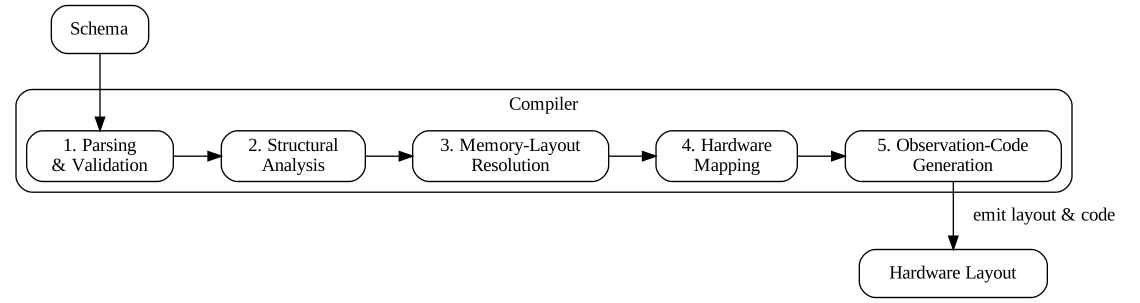
The SSCCS compiler transforms a high-level schema into a hardware-specific layout through a deterministic pipeline.
- Parsing and Validation: The open‑format
.ssfile (see [13]) is parsed into an intermediate representation (IR). The parser validates syntax and semantics, computes cryptographic identities (SchemaId, SegmentId), and produces a binary representation that preserves the topological structure. - Structural Analysis: The compiler extracts adjacency and dependency relations. It identifies independent sub-graphs that can be observed concurrently.
- Memory-Layout Resolution: Using the Schema’s
MemoryLayoutspecification, the compiler resolves the mapping from coordinate space to logical addresses. This stage produces a logical address map that preserves locality. - Hardware Mapping: The logical address map is projected onto the target hardware’s physical memory hierarchy. The compiler arranges Segments so that structurally adjacent Segments reside in physically proximate storage locations—e.g., the same cache line, adjacent memory banks, or custom address decoder regions. This strategy applies uniformly across conventional CPU/GPU targets and, where supported, emerging memory-centric architectures, but does not require any specific hardware capability.
- Observation-Code Generation: For each sub-graph, the compiler emits native code that implements the observation operator
Ω.
The entire pipeline is deterministic and reproducible: given the same specification and target hardware profile, the compiler always produces the same layout and observation code.
3.3 Structural Analysis
The second pipeline stage, Structural Analysis, extracts adjacency and dependency relations from the Scheme’s relation set \(R\). The compiler performs a graph-theoretic analysis to identify independent sub-graphs that can be observed concurrently.
Concretely, the compiler constructs a directed graph where vertices are Segments and edges are relations of type Dependency. Strongly connected components (SCCs) of this dependency graph are identified; each SCC forms a candidate for sequential observation because dependencies within a component create cyclic constraints. Sub-graphs with no edges between them are marked as independent and can be scheduled in parallel. For relations of type Adjacency and Hierarchy, the compiler uses them to guide locality optimization in later stages, but they do not impose observation ordering.
This analysis is purely structural and does not depend on runtime values, ensuring deterministic parallelism. The output of this stage is a partition of the Scheme into observation units, each with its own logical-address map and observation code.
3.4 Hardware Topology Embedding
3.4.1 Logical Address Virtualization Layer
The compiler’s ability to eliminate data movement hinges on the MemoryLayout abstraction. A MemoryLayout consists of a layout_type (e.g., RowMajor, SpaceFillingCurve), a mapping function, and metadata.
A logical address is an intermediate representation: a segment identifier and an offset within that segment’s conceptual address space. It is not a physical address; rather, it serves as an intermediate coordinate that the hardware mapper later translates to concrete physical locations.
Example: For a 2D grid with row-major layout: \[f(x, y) = (\text{grid\_id},\; y \cdot \text{width} + x)\]
The compiler evaluates this function for every coordinate in the Schema, producing a complete logical-address map. This mapping preserves row-wise adjacency: for a \(3\times 3\) grid, the logical addresses are \((0,0)\to0\), \((1,0)\to1\), \((2,0)\to2\), \((0,1)\to3\), etc.
Other layout types are handled analogously. For a column-major layout the mapping becomes \(f(x, y) = x \cdot \text{height} + y\); for a space-filling curve (e.g., Z-order) the compiler interleaves the bits of the coordinates. Hierarchical layouts recursively apply a base layout within each block, enabling multi-level locality. Graph-based layouts assign logical addresses according to a graph-traversal order (e.g., breadth-first search) that respects the adjacency relations declared in the Scheme.
Each layout type is defined in the Schema’s MemoryLayout specification (see [18.3]). The compiler evaluates the corresponding mapping function for every coordinate, producing a deterministic logical-address map that is then passed to the hardware-mapping stage.
3.4.2 Target-Hardware Mapping Strategies
The logical address space acts as a virtualization layer, decoupling structural description from physical implementation. The same Schema can be embedded into vastly different hardware substrates while preserving the core principle: structurally adjacent Segments reside in physically proximate storage locations.
Rather than prescribing a fixed hardware target, the compiler adapts the logical-address map to the memory hierarchy and parallelism available on the underlying substrate. On cache-based CPUs, the compiler groups adjacent Segments into cache-line-aligned blocks, ensuring that a single fetch retrieves all data needed for a local observation. For architectures with explicit spatial parallelism (e.g., reconfigurable fabrics), the mapping can be hardwired into address-decode logic, turning observation into a combinatorial propagation. High-bandwidth memory systems allow Segments to be distributed across independent channels, overlapping accesses to maximize throughput. Emerging non-volatile memories can be treated as a static coordinate manifold, enabling direct structural projection without address translation.
Where hardware capabilities allow (e.g., processing-in-memory or other memory-centric computing), the compiler may offload entire observation units to the memory substrate, translating the logical map into device-specific commands that perform observation without moving data. Crucially, even on conventional von Neumann hardware, SSCCS overlays a structural interpretation: the compiler translates logical addresses into standard load/store operations, but the overall computation remains free of data movement because all necessary data is already resident where observation occurs. A detailed discussion of hardware profile variants and mapping strategies is provided in [15].
3.5 Observation-Code Generation
The fifth pipeline stage emits executable code that implements the observation operator \(\Omega\) for each independent sub-graph identified during structural analysis. The form of the generated code adapts to the target hardware’s capabilities:
Conventional CPUs: The compiler emits SIMD loops that iterate over the logical-address ranges produced by the layout stage. Each iteration evaluates the projector \(\pi\) for a Segment and accumulates the result into a projection buffer. The loops are automatically vectorised and unrolled according to the hardware’s SIMD width.
Reconfigurable fabrics: For architectures that support spatial computation, the compiler can generate a netlist that hardwires the address mapping into the interconnect fabric. The observation operator becomes a combinatorial propagation, eliminating fetch-execute overhead.
Processing-in-memory substrates: Where memory-centric compute units are available, the compiler produces a sequence of its commands that are sent directly to the memory controller. Each command triggers an observation within a memory bank, removing data movement between memory and processing unit.
The generated code is deterministic and reproducible: given the same Scheme and hardware profile, the compiler emits identical observation code every time. This property enables ahead-of-time verification and eliminates runtime compilation overhead. A detailed methodology for observation-code generation is provided in [14].
3.6 System Stack and Runtime
SSCCS inserts a runtime layer between application and hardware that translates observation requests into hardware-specific memory mappings.
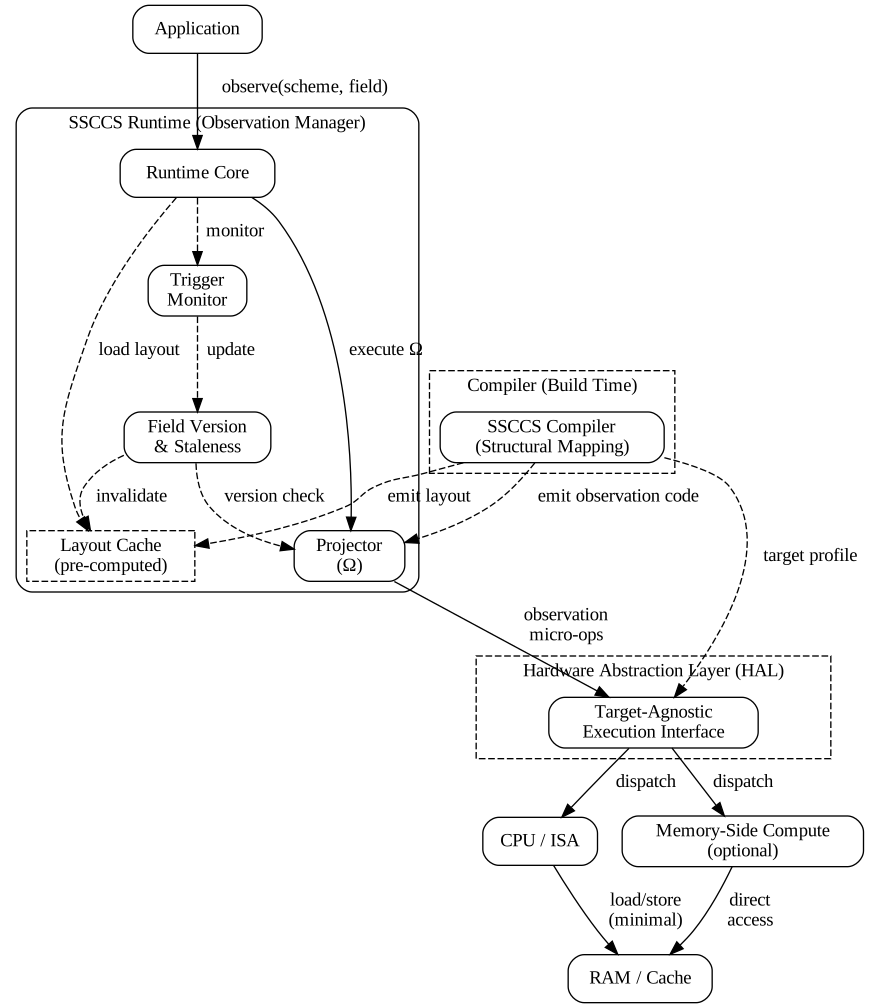
Upon receiving an observe(scheme, field) call, the runtime loads the pre-computed memory layout from the layout cache, invokes the projector, and returns the resulting projection. The projector translates the logical addresses produced by the compiler into hardware-specific memory accesses, using dedicated observation instructions when available. This decouples the structural mapping (done at compile time) from the dynamic observation (done at runtime), enabling portable performance across heterogeneous hardware.
3.6.1 Future Hardware Considerations
While SSCCS can be implemented in software, its long-term hardware trajectory — a dedicated silicon compiler [9] — produces a static constraint-resolution fabric with no program counter, no instruction fetch unit, and no data cache. The compiler partitions segments, routes constraint signals, and generates projection paths directly from scheme descriptions.
The OpenHW CORE-V MCU [10] and its eXtension Interface (XIF) [11] enable prototyping of observation primitives as tightly coupled coprocessor extensions, supported by eFPGA fabrics [12] and formal verification tools [13]. Radiation-hardened RISC-V implementations and ESA’s TRISTAN roadmap [14] demonstrate the shift toward deterministic, mixed-criticality processors, with recent advances in fault-tolerant decoding [15], dynamic lockstep [16], and radiation-hardening efficacy [17], [18] illustrating ecosystem readiness. PIM reduces data-movement distance by placing compute near memory. SSCCS eliminates data movement as a concept: data remains stationary at its scheme coordinate, and computation consists only of constraint resolution across the topology.
3.7 Implementation Cases
The appendix examples below show how the compiler pipeline translates high-level specifications into hardware-specific layouts.
4 Theoretical Performance & Scalability
SSCCS changes the asymptotic complexity profile compared to procedural models.
4.1 Architectural Expectations of Time-Space Complexity
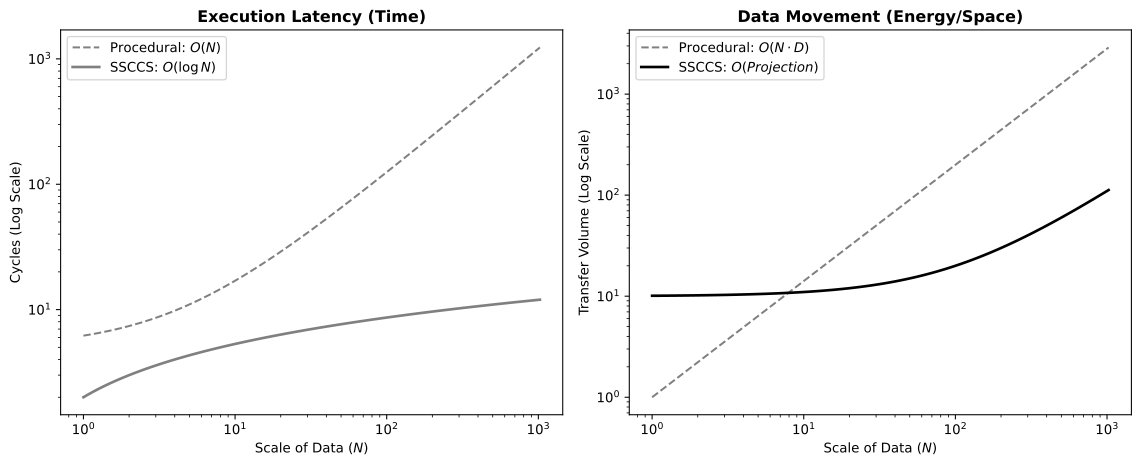
Traditional procedural models are constrained by the linear relationship between data volume (\(N\)) and execution cycles. SSCCS decouples this relationship by utilizing the concurrent propagation of a Field across a pre-defined Topology.
4.1.1 Temporal Complexity (Latency)
In a von Neumann environment, latency scales at \(O(N)\) or \(O(N/k)\) due to instruction dispatch and synchronization.
- SSCCS Latency: Defined by the physical propagation delay of the Field across the Scheme. The observation of the result theoretically approaches near-\(O(1)\) in emerging hardware paradigms (e.g. Processing-In-Memory (PIM)).
4.1.2 Data Movement Complexity (Spatial/Energy Cost)
The primary energy sink in modern computing is the movement of operands from memory to logic units.
- Procedural Cost: \(O(N \cdot D)\).
- SSCCS Cost (Logic-at-Rest): \(O(Projection)\). Since the input Segments remain stationary, the energy expenditure is strictly limited to the transmission of the resulting Projection.
4.2 Comparative Complexity Matrix
| Metric | Sequential | Parallel (SIMD/GPU) | SSCCS (Structural) |
|---|---|---|---|
| Instruction Overhead | High (\(O(N)\)) | Moderate (\(O(N/k)\)) | Minimal (Field-based) |
| Data Locality | Managed (Cache) | Explicit (SRAM/Tiling) | Intrinsic (Scheme-defined) |
| Execution Latency | \(O(N)\) | \(O(N/k) + \text{sync}\) | \(O(\log N)\) or \(O(1)\) |
| Data Movement | \(O(N)\) | \(O(N)\) | \(O(\text{Output Only})\) |
| Scalability Limit | Amdahl’s Law | Memory Bandwidth | Physical Propagation Delay |
An observation, however structured, must execute on a physical substrate. The compiler’s layout decisions carry a bandwidth-compute balance constraint: for any observation unit, the product of its compute footprint and the required data rate must not exceed what the target substrate can supply per cycle. When this condition is unmet, the observation stalls regardless of structural independence. The MemoryLayout abstraction is therefore not merely an optimisation—it is a constraint-satisfaction problem whose solution determines whether an observation is executable on a given hardware profile. Empirical analyses of this balance condition in conventional vector architectures are referenced in [21].
4.3 Scalability in High-Dimensional AI Workloads
As demonstrated in the emergence of State-Space Models (SSMs) [19] and manifold-constrained learning [20], the ability to process high-dimensional representations without exhaustive data shuffling is critical.
- Stationary Topology: By fixing the Segments in a k-dimensional
MemoryLayout, SSCCS allows the hardware to perform “Observation” as a near-instantaneous mapping. - Implicit Parallelism: Unlike threads or warps that require explicit management, SSCCS parallelism is implicit—it is a property of the structure itself.
6 Development Roadmap and milestones
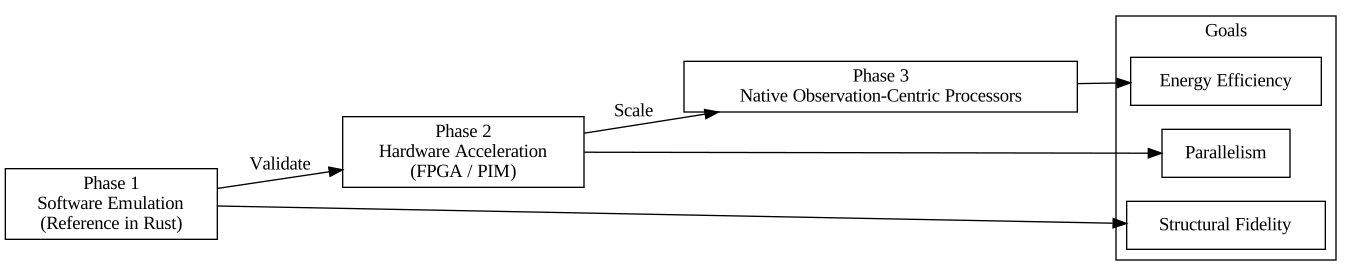
The development roadmap [8] follows a three-phase progression, beginning with Rust‑based software emulation (drawing on established bare‑metal Rust practices [29], [30]) and proof‑of‑concept implementations [9], and culminating in native observation‑centric hardware. A dual-layer compiler architecture bridges the transition from existing von Neumann systems, enabling incremental migration. This strategy prioritizes empirical validation in high-performance domains, demonstrating energy efficiency and deterministic execution through structural observation. For details, refer to the appendices tagged above.
7 Conclusion and Future Work
SSCCS establishes five foundational principles:
- Computation concerns revelation rather than change.
- Structure is more fundamental than process.
- Time is a coordinate rather than a flow.
- Value is projected rather than intrinsic.
- Immutability enables parallelism and verifiability.
The most significant departure is the treatment of time as one coordinate among many, which eliminates global sequentiality and enables lock-free concurrency. The compiler’s role correspondingly shifts from instruction scheduling to topological optimization: mapping logical adjacency directly onto physical locality.
Open questions remain: formal treatment of nested Field dynamics, compiler infrastructure for geometric constraints at scale, and empirical validation of energy efficiency gains across target domains. The open .ss format [13] is a first step toward making these ideas concrete and composable, and will be updated as the specification evolves through implementations across projects.
SSCCS is not proposed as a universal replacement. For problems that are inherently sequential or interaction-dominant, traditional models may remain appropriate. But for data-intensive, parallel workloads where the von Neumann bottleneck dominates, this model offers a different trade-off.
Appendices
8 Project Roadmap
SSCCS is designed for incremental adoption—start with software emulation today, transition to hardware acceleration as the technology matures, and ultimately deploy on native observation-centric processors. The open format ensures that investment in specification outlives any particular implementation.
8.1 Implementation Phases
8.1.1 Phase 1: Software Emulation (Proof of Concept)
- Rust reference implementation reading the SS format specifications.
- Core concepts validated on RISC-V simulation (Spike) with 271 test cases passing across all concept types. Deterministic reproducibility confirmed across independent implementations (Rust and C). The inverse-validation exercise described in the Introduction further demonstrates the model’s applicability to conventional RISC-V silicon [1].
- SystemVerilog composition model provides additional cross-validation at the HDL level.
- Ongoing: measure determinism, implicit parallelism, data movement reduction on larger benchmarks.
8.1.2 Phase 2: Hardware Acceleration (Transitional)
- Map Schemes to FPGA fabrics.
- Utilize PIM architectures as transitional substrate (UPMEM, Samsung FIM).
- Develop compiler targeting CPUs (via SIMD) and FPGA/PIM.
- Begin formal verification.
8.1.3 Phase 3: Native Observation-Centric Processors (Long-Term Research)
- Design processor directly instantiating Schemes.
- Integrate memory and logic in unified substrate (e.g., memristor arrays).
- Evaluate energy efficiency for target domains.
8.2 Compiler Layer as Migration Bridge
The SSCCS compiler serves a dual purpose:
Adaptive Embedding (Phase 1-2): Translate Schemes into von Neumann-compatible code (load/store, SIMD) or PIM primitives, accepting abstraction overhead.
Example: A climate model grid can be compiled to standard C + OpenMP today, while retaining the same format specification for future hardware.
Direct Instantiation (Phase 3): Map Schemes directly to observation-centric hardware primitives, eliminating compatibility layers.
Example: The same scheme grid can later be synthesized directly onto a memristor array without rewriting.
This dual capability enables gradual migration without requiring a “flag day” switchover. Organizations can adopt SSCCS incrementally, deploying on existing infrastructure while preparing for native hardware.
8.3 Domain Validations
SSCCS is intended for validation across multiple domains.
9 PoC Implementation Notes
The SSCCS Proof of Concept (PoC) is a Rust-based reference implementation of the core ontological layers defined in this specification. It corresponds to Phase 1 (software emulation) of the development roadmap. This appendix documents implementation details that complement the open-format specification [13].
9.1 Why Rust
Rust was chosen for the reference implementation. Its properties align with the SSCCS model: immutability by default, zero-cost abstractions, concurrency without data races, strong type system for structural invariants, and fine-grained control over memory layout [29], [30].
9.2 Core Types
9.2.1 Segment
A Segment is an immutable coordinate point in a multi‑dimensional possibility space. Its identity is a BLAKE3 cryptographic hash derived from its coordinates, guaranteeing uniqueness and verifiability.
pub struct Segment {
    coordinates: SpaceCoordinates,
    id: SegmentId,
}
9.3 Scheme Abstraction Layer
The Scheme abstraction captures the static topological blueprint of a computation. It consists of:
- Axes – dimensional definitions (
Discrete,Continuous,Cyclic,Categorical,Relational,WithUnit). - Structural Relations – adjacency, hierarchy, dependency, equivalence, and custom predicates.
- Memory‑Layout – mapping from coordinate space to logical addresses (
Linear,RowMajor,ColumnMajor,SpaceFillingCurve,Hierarchical,Graph‑Based,Custom). - Observation Rules – resolution strategies, triggers, priority, and context.
The layer provides ready‑to‑use templates (Grid2DTemplate, IntegerLineTemplate, GraphTemplate) that combine these elements into common topological patterns.
9.3.1 Field
A Field holds dynamic constraints (ConstraintSet) and a TransitionMatrix that encodes weighted directed‑graph relationships between Segments. The constraints determine which Segments are admissible; the transition matrix influences how observation propagates across the topology.
9.3.2 Projector Trait
The Projector trait defines the semantic interpretation of a Segment–Field pair, producing a projection (the observable “value”). It also optionally specifies possible next coordinates, enabling adjacency to be defined through the projector itself.
pub trait Projector {
    type Output;
    fn project(&self, field: &Field, segment: &Segment) -> Option<Self::Output>;
    fn possible_next_coordinates(
      &self,
      coords: &SpaceCoordinates
    ) -> Vec<SpaceCoordinates> { vec![] }
}
Three example projectors are:
IntegerProjector– extracts a coordinate along a given axis.ArithmeticProjector– defines adjacency through arithmetic operations (+1,-1,*2,/2).ParityProjector– classifies coordinates as"even"or"odd"strings.
9.4 Compiler Pipeline
A four‑stage compiler pipeline translates a high‑level Scheme into hardware‑specific layouts:
- Parsing and Validation – reads the
.ssbinary and builds an intermediate representation. - Structural Analysis – extracts adjacency and dependency relations, identifies independent sub‑graphs for parallel observation.
- Memory‑Layout Resolution – applies the Scheme’s
MemoryLayoutto map coordinates to logical addresses. - Hardware Mapping – projects logical addresses onto the target hardware’s physical memory hierarchy (CPU caches, FPGA Block‑RAM, PIM banks).
The pipeline is generic over a HardwareProfile (GenericCPU, FPGA, PIM, Custom), allowing the same Scheme to be optimized for different substrates.
10 Vector Addition Example
Consider the addition of two vectors of length \(N\).
10.1 Traditional Approach
In a traditional architecture, a loop iterates over indices, loading each element from memory into registers, performing the addition, and storing the result back.
fn add_vectors(a: &[f64], b: &[f64]) -> Vec<f64> {
    assert_eq!(a.len(), b.len());
    let mut result = Vec::with_capacity(a.len());
    for i in 0..a.len() {
        result.push(a[i] + b[i]); // loads a[i], b[i]; stores result[i]
    }
    result
}- Data Movement: \(2N\) loads + \(N\) stores = \(3N\) total memory transfers.
- Sequential Dependency: Loop-carried dependencies limit parallelisation.
- Cache Behaviour: Performance is highly dependent on memory layout; random access or misalignment causes cache misses.
10.2 SSCCS Approach
A Scheme defines a set of Segments representing the vectors. The compiler lays out the Segments consecutively in memory. An observation of the entire structure yields a projection that is the sum vector.
let a = Segment::vector(0..N, initial_values);
let b = Segment::vector(0..N, initial_values);
let scheme = Scheme::add_vectors(a, b);
let field = Field::new();
let sum = observe(scheme, field);- Data Movement: Input segments are not relocated. Only the resulting projection (a single vector of length \(N\)) is transmitted.
- Parallelism: Structural independence allows all element pairs to be observed concurrently without explicit synchronisation or partitioning.
- Locality: Enforced by the compiler’s topological mapping, treating memory as an active topology rather than passive storage.
10.2.1 Comparison Table
| Aspect | Traditional (Procedural) | SSCCS (Structural) |
|---|---|---|
| Input Data Movement | \(2N\) loads | Zero (Stationary Segments) |
| Output Data Movement | \(N\) stores | \(N\) (Projection) |
| Concurrency | Requires explicit parallelisation | Implicit (Structural independence) |
| Synchronisation | Locks/atomics for shared state | None (Immutability guaranteed) |
| Memory Role | Passive storage | Active topology |
| Auditability | Requires external tracing | Intrinsic to Specification |
11 Scaling to N-Dimensional Tensors and Graphs
The structural principles of SSCCS extend beyond linear vectors to higher-dimensional and non-linear data structures.
11.1 N-Dimensional Tensors
In SSCCS, an \(N\)-dimensional tensor is represented as a set of Segments where adjacency relations are defined across multiple axes within the Scheme.

- Reshaping without data movement: Traditional systems require physical data movement to perform operations like transposition or reshaping. In SSCCS, reshaping is a metadata-only operation: reorienting the Field’s observation path over stationary Segments changes the dimensionality of the Projection without moving data in memory.
- Logical Adjacency: For operations like matrix multiplication, the compiler maps Segments so that operands required by a Field are physically co-located. This transforms indexing logic into a property of the memory topology.
12 Complex Graph Processing
Graph algorithms (e.g., PageRank, GNNs) are traditionally bottlenecked by “Pointer Chasing,” which causes severe cache thrashing and memory latency.
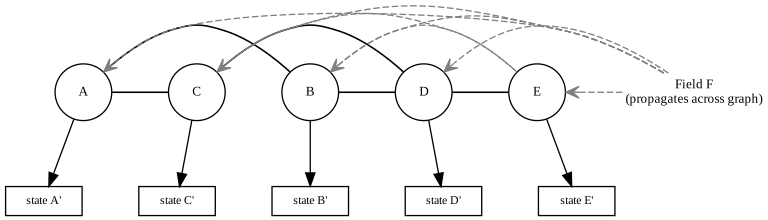
- Segment-as-Node: Each node and its properties are encapsulated in a Segment.
- Adjacency-as-Structure: Edges are defined as structural constraints within the Scheme, not as memory pointers to be followed sequentially.
- Field-based Traversal: A Field propagates across the entire Scheme in a single observation cycle. All nodes are evaluated concurrently rather than visited sequentially.
- Concurrency: Vertex-centric synchronization (locks, mutexes) is not required. All nodes update in parallel as a consequence of the Field’s interaction with the Scheme’s topology.
12.1 Comparison: Computational Density at Scale
| Computational Task | Traditional Bottleneck | SSCCS Solution |
|---|---|---|
| Tensor Reshaping | Physical data reshuffling (\(O(N^d)\)) | Metadata-level Field reorientation (\(O(1)\)) |
| Matrix Contraction | Memory bandwidth & indexing overhead | Hardwired adjacency in the Scheme |
| Graph Traversal | High latency due to random access | Distributed parallel observation |
| Sparse Operations | Complex indexing & storage overhead | Non-linear Scheme mapping (skipping null-space) |
SSCCS decouples the logical structure of data from the physical cost of traversal. Traditional architectures move data to accommodate logic; SSCCS modifies the Field to accommodate the stationary structure.
13 Open Format Specification (Draft)
The .ss format is a declarative language for specifying the topological structure of an SSCCS computation. It describes the geometric and relational properties of a computational space, leaving all physical mapping decisions to the hardware-specific compiler backend.
A .ss description specifies coordinate space, relations, and observation constraints. No registers, clocks, or circuits appear, because the same topology can compile to RTL, FPGA bitstream, CPU loop, or formal model without rewriting.
13.1 Core Components
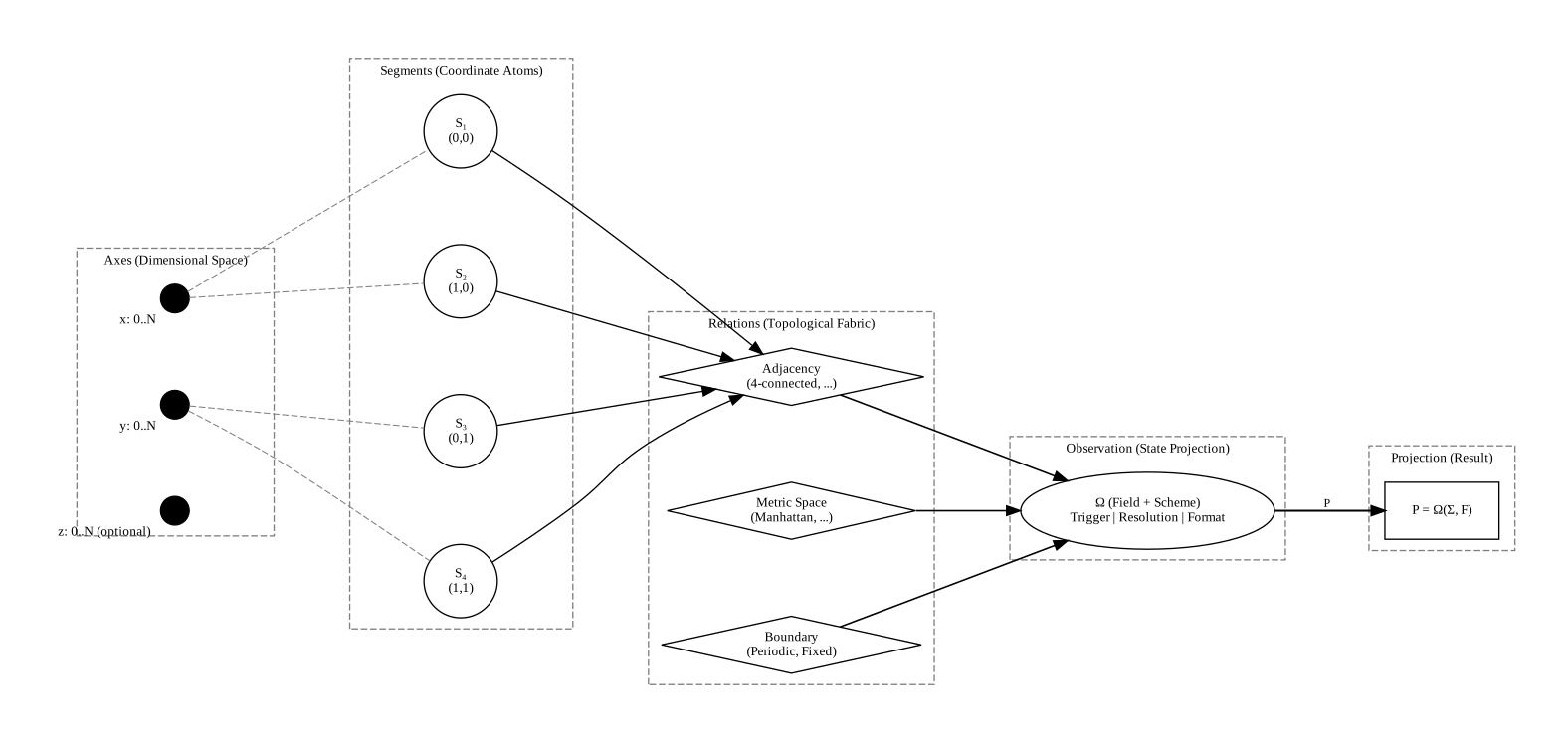
The following diagram illustrates how the four core components of a .ss description relate to each other. Notice that no memory layout or instruction flow appears – only the static topology of the computation.
13.2 Component Details
13.2.1 Axes
Define the coordinate space: names, ranges (discrete or continuous), and optional manifold properties (e.g., toroidal, bounded). They establish the dimensional foundation upon which Segments are placed.
13.2.2 Segments
Atomic coordinate points. Each Segment is identified by its coordinates \((x, y, z, \dots)\) and a cryptographic hash derived from them. Segments are immutable and stateless – they carry no values, only position.
13.2.3 Relations
Relations replace traditional control flow (loops, conditionals) with a static description of connectivity and proximity. The topological fabric that connects Segments. This block encodes:
- Adjacency: How Segments are connected (e.g., 4‑connected, 8‑connected, arbitrary graph).
- Metric Space: The distance function \(d(s_i, s_j)\) that governs interaction strength (e.g., Manhattan, Euclidean, graph distance).
- Boundary Conditions: The shape of the manifold (e.g.,
Periodicfor a torus,Fixedfor a finite grid).
13.2.4 Observation
Defines how a Field’s dynamic constraints interact with the static Scheme to produce a Projection. It includes:
- Trigger: The condition that initiates observation (e.g.,
Equilibrium,ExternalPulse,Timer). - Resolution Strategy: How multi‑segment interactions are resolved into a single output (e.g., summation, maximum, tensor contraction).
- Projection Format: The mathematical type of the result (e.g., scalar, vector, tensor).
13.3 Key characteristics
- Non‑linear addressing – Segments are identified by coordinate tuples, not memory offsets.
- Relation‑defined computation – What traditional code expresses as loops and conditionals is encoded in the connectivity and metric of the
Relationsblock. - Observation as collapse – The
Observationblock specifies how a Field’s constraints resolve the Scheme’s potential into a deterministic Projection. - Deferred physical mapping – No memory layout or instruction sequence is included; the compiler backend maps the topology to concrete hardware (SRAM, DRAM, HBM, etc.) based solely on the declared relations.
- Deferred physical mapping — No memory layout or instruction sequence is included; the compiler backend maps the topology to concrete hardware (SRAM, DRAM, HBM, etc.) based solely on the declared relations.
- Irreversibility of execution — Execution moves forward only. A Scheme compiled and observed produces a Fact that cannot be retroactively altered. Legal instruments can be contested; execution traces cannot. An entity that copies the entire open specification and begins from the same primitives has gained nothing but yesterday’s state. It still faces its own execution path alone, without the accumulated trajectory of those who have already run theirs. The barrier is not access to knowledge but the direction of time itself.
13.4 Cryptographic Identity
A Schema’s identity is derived solely from its topological properties. Changing a physical implementation detail (e.g., cache‑line alignment) does not affect the SchemeId. However, altering the connectivity or the metric space produces a new, distinct identity:
\[SchemeId = H(\text{Axes} + \text{Segments} + \text{Relations} + \text{ObservationRules})\]
14 Observation‑Code Generation Methodology
This appendix expands on the observation‑code generation stage described in Section 3.5 of the whitepaper, providing concrete implementation techniques for CPU, FPGA, and PIM targets. It illustrates how the SSCCS compiler lowers the high‑level structural description to executable native code while preserving determinism and reproducibility.
14.1 Lowering to LLVM/MLIR
The SSCCS front‑end translates a Scheme and its associated Field into an intermediate representation (IR) expressed in a custom MLIR dialect named ssccs. This dialect captures the topological relationships, coordinate mapping, and observation semantics as MLIR operations. The following snippet illustrates a simplified ssccs.observation operation:
func.func @observe_vector(
  %scheme: !ssccs.scheme,
  %field: !ssccs.field
) -> tensor<8xf32> {
  %result = ssccs.observation %scheme, %field
           {layout = #ssccs.layout<row_major>,
            projector = #ssccs.projector<add>}
           : (!ssccs.scheme, !ssccs.field) -> tensor<8xf32>
  return %result : tensor<8xf32>
}
The ssccs dialect is then lowered to standard MLIR dialects (e.g., affine, scf, vector) via a series of progressive rewrites, ultimately emitting LLVM IR. This approach leverages the existing LLVM optimisation pipeline for generic CPU targets.
14.2 CPU Target: SIMD Loop Generation
For CPU execution, the compiler emits C/C++ loops that iterate over the logical‑address ranges produced by the layout stage. The loops are automatically vectorised using LLVM’s auto‑vectorisation or explicit SIMD intrinsics. The following pseudocode shows the kernel generated for a simple vector‑addition observation:
void observe_vector(
  float* projection,
  const float* segment_a,
  const float* segment_b,
  size_t N
) {
  #pragma omp simd aligned(projection, segment_a, segment_b: 64)
  for (size_t i = 0; i < N; i += 8) {
    __m256 a = _mm256_load_ps(segment_a + i);
    __m256 b = _mm256_load_ps(segment_b + i);
    __m256 sum = _mm256_add_ps(a, b);
    _mm256_store_ps(projection + i, sum);
  }
}
The compiler ensures cache‑line alignment, loop unrolling, and proper use of prefetch instructions according to the target micro‑architecture. The generated code is deterministic: the same Scheme and hardware profile produce identical binary loops every time.
14.3 FPGA Target: Verilog Netlist Generation
For FPGA targets, the compiler bypasses instruction‑based execution and directly synthesises a hardware circuit that implements the observation operator. The logical‑address map is turned into a hardwired address decoder; each Segment coordinate becomes a static connection to a Block‑RAM location. The observation operator is expressed as a combinatorial or pipelined data‑path. A simplified Verilog example:
module observe_vector (
  input wire [31:0] segment_a [0:7],
  input wire [31:0] segment_b [0:7],
  output wire [31:0] projection [0:7]
);
  generate
    for (genvar i = 0; i < 8; i = i + 1) begin
      assign projection[i] = segment_a[i] + segment_b[i];
    end
  endgenerate
endmodule
The compiler uses high‑level synthesis (HLS) tools (e.g., Xilinx Vitis HLS, Intel HLS) or direct RTL generation, depending on the backend. The resulting netlist can be placed and routed on the target FPGA, delivering zero‑overhead observation with deterministic latency.
14.4 PIM Target: Command‑Sequence Generation
When targeting processing‑in‑memory (PIM) substrates (e.g., UPMEM DPUs, Samsung FIM), the compiler emits a sequence of PIM commands that are sent directly to the memory controller. Each command triggers an observation within a memory bank, eliminating data movement between memory and CPU. The command sequence is derived from the logical‑address map and the observation operator. An example using a hypothetical PIM SDK:
PIMCommand cmd = {
  .op = PIM_OP_OBSERVE,
  .bank = 0,
  .address = LOGICAL_TO_PHYSICAL(segment_a),
  .operator = PIM_OPERATOR_ADD,
  .operand = LOGICAL_TO_PHYSICAL(segment_b)
};
pim_submit_command(cmd);
pim_wait_completion();
The compiler leverages vendor‑specific SDKs to generate optimal command sequences that maximise bank‑level parallelism and minimise synchronisation overhead. Because PIM commands are deterministic, the same observation always yields the same result.
14.5 Integration with Existing Toolchains
SSCCS deliberately builds upon established compiler and hardware toolchains to reduce implementation risk:
- LLVM/MLIR: Provides mature optimisation passes, code generation for a wide range of CPUs, and a flexible dialect infrastructure.
- Verilator & vendor HLS tools: Enable FPGA target simulation and synthesis.
- PIM SDKs (e.g., UPMEM, Cerebras, Samsung/SK Hynix, Mythic) provide the software toolchains needed to program near‑memory compute units. They typically include libraries for data movement, runtime APIs for launching parallel kernels, and debugging/profiling tools. Open‑source and research frameworks (PIMSys, DaPPA, SimplePIM, gem5‑based simulators) further facilitate PIM software development.
By reusing these ecosystems, SSCCS focuses innovation on the structural abstraction rather than on low‑level code generation, ensuring that the novel paradigm can be validated on available hardware today.
15 Hardware Profile Variants and Mapping Strategy
The SSCCS compiler adapts the structural description of a Scheme to concrete hardware through a set of hardware profiles. Each profile defines a class of hardware substrates (e.g., conventional CPUs, reconfigurable fabrics, processing‑in‑memory units, or custom accelerators) and provides a mapping strategy that transforms the logical‑address map produced by the layout stage into hardware‑specific memory accesses or direct physical connections. This appendix details the four canonical profiles—CPU, FPGA, PIM, and Custom—and explains how the compiler implements the mapping strategy for each.
15.1 CPU Profile
The CPU profile targets conventional von Neumann processors equipped with multi‑level caches, SIMD units, and virtual memory. The mapping strategy focuses on maximizing locality and exploiting data‑parallelism while minimizing data movement across the memory hierarchy.
- Cache‑line alignment: Segments are grouped into blocks that fit exactly into a cache line (typically 64 bytes). The compiler ensures that structurally adjacent Segments reside in the same cache line, allowing a single fetch to retrieve all data needed for a local observation.
- Multi‑core parallelism: Independent sub‑graphs identified during structural analysis are scheduled across available cores via OpenMP or a lightweight runtime scheduler.
- Vectorized observation loops: The compiler automatically generates SIMD loops that iterate over the logical‑address ranges, leveraging the target’s SIMD width (e.g., AVX‑512, NEON). Details of observation‑code generation for CPUs are provided in [14].
The CPU profile relies on the standard load/store paradigm; however, because Segments are stationary, the only data movement is the transmission of the resulting projection. This profile is the fallback for any hardware that lacks specialised acceleration.
15.2 FPGA Profile
The FPGA profile targets reconfigurable fabrics that can hardwire the topological relations of a Scheme into the interconnect fabric. Mapping is spatial rather than sequential: each Segment coordinate becomes a static connection to a Block‑RAM location, and the observation operator is implemented as a combinatorial or pipelined data‑path.
- Netlist synthesis: The compiler generates a Verilog (or VHDL) netlist that directly instantiates the logical‑address map as an address decoder and the projector as a hardware circuit.
- Scalability: Large Schemes are partitioned across multiple FPGA tiles, with inter‑tile communication following the Scheme’s adjacency relations.
- Zero‑overhead observation: Once the circuit is placed and routed, observation occurs in a single clock cycle (combinatorial) or a short pipeline, eliminating fetch‑execute overhead. For a concrete example of FPGA netlist generation, see the FPGA‑target subsection of [14].
The FPGA profile delivers deterministic, low‑latency observation for fixed‑topology computations, making it ideal for streaming applications and real‑time signal processing.
15.3 PIM (Processing‑In‑Memory) Profile
The PIM profile leverages memory‑centric compute units that reside inside or near memory banks. Mapping transforms the logical‑address map into a sequence of PIM commands that are executed directly by the memory controller, eliminating data movement between memory and a separate processor.
- Command‑sequence generation: For each observation unit, the compiler emits a series of vendor‑specific commands (e.g.,
PIM_OP_OBSERVE) that specify the operator, bank addresses, and operand locations. - Bank‑level parallelism: Commands are scheduled across independent memory banks to maximise throughput.
- Deterministic execution: PIM commands are deterministic; the same observation always yields the same result, enabling verifiable computation inside the memory subsystem. The PIM‑target subsection of [14] provides a detailed command‑sequence example.
The PIM profile is particularly beneficial for data‑intensive workloads where the von Neumann bottleneck would otherwise dominate energy consumption.
15.4 Custom Profile
The Custom profile allows hardware designers to define their own mapping strategy through a plugin interface. A custom profile consists of a mapping function that translates logical addresses to physical addresses and an observation‑code generator that emits target‑specific instructions or configuration bitstreams.
- Plugin architecture: The compiler loads a dynamic library (or a Rust crate) that implements the
HardwareProfiletrait, providing methods for address translation and code generation. - Arbitrary hardware: This profile can target emerging substrates such as memristor arrays, optical interconnects, or quantum‑inspired accelerators.
- Experimentation: Researchers can prototype novel hardware mappings without modifying the core compiler.
The Custom profile ensures that SSCCS remains extensible as new hardware paradigms emerge.
15.5 Summary of Mapping Strategies
| Profile | Target Hardware | Key Mapping Strategy | Data Movement | Latency Characteristic |
|---|---|---|---|---|
| CPU | Conventional processors with caches & SIMD | Cache‑line alignment, vectorized loops | Projection only | \(O(N)\) (but vectorised) |
| FPGA | Reconfigurable fabrics (Xilinx, Intel) | Netlist synthesis, spatial wiring | None (combinatorial) | \(O(1)\) after placement |
| PIM | Memory‑side compute units (UPMEM, Samsung FIM) | PIM command sequences | None (in‑memory) | \(O(\text{bank access})\) |
| Custom | User‑defined accelerators | Plugin‑defined translation | Plugin‑defined | Plugin‑defined |
15.6 Integration with the Compiler Pipeline
The hardware profile is selected at compile time via a command‑line flag (e.g., --profile cpu). The compiler’s hardware‑mapping stage consults the profile to decide how to lower the logical‑address map and generate observation code. The same Scheme can be compiled for different profiles, yielding functionally identical projections but with performance and energy characteristics tailored to the underlying substrate.
Detailed examples of observation‑code generation for each profile are given in [14]. The mapping strategies described here are referenced from the main whitepaper’s discussion of target‑hardware mapping (see Section 3.4.2).
16 Fault Tolerance Computing in Extreme Environments
SSCCS applies to radiation-tolerant and safety-critical computing by replacing static hardware hardening with software-defined resilience. This appendix details the technical relationship between SSCCS Fields and RISC-V platforms [11], focusing on OpenHW CORE-V integration, custom instruction design, and cryptographic deployment protocols.
16.1 Problem Context
Conventional Radiation Hardening by Design (RHBD) relies on fixed mechanisms like Triple Modular Redundancy (TMR) and SECDED ECC. While effective against Single Event Upsets (SEUs), these approaches suffer from:
- Static Overhead: Protection is fixed at fabrication (~200% area/power for TMR).
- Semantic Blindness: Bit-wise correction cannot detect logically impossible states (e.g., velocity exceeding physical limits).
- Rigidity: Cannot adapt to evolving radiation environments or mission phases without pre-designed overhead.
SSCCS addresses these through software-defined radiation hardening, where fault-tolerance policies are deployed as composable, cryptographically signed Field binaries.
16.2 SSCCS: Distributed Executable Field (Draft)
Fields are compiled into platform-independent executable binaries containing constraint bytecode and transition matrices. The header structure ensures cryptographic integrity and runtime sandboxing:
field_header:
  magic: "SSCCS_FLD"          # 8B identifier
  version: uint16             # Format version (0x0100)
  signature_alg: uint8        # Ed25519=1, ECDSA-P256=2
  constraint_type: uint8      # Dimensional=1, Algebraic=2, Semantic=3
  code_offset: uint32         # Byte offset to constraint bytecode
  data_offset: uint32         # Byte offset to T-matrix/parameters
  code_size: uint32           # Bytecode section size
  data_size: uint32           # Parameter section size
  timeout_cycles: uint16      # Max execution cycles for constraint eval
  signature: byte[64]         # Cryptographic signature (header+payload)
16.3 IF Custom Instructions & Handshake Protocol
Efficient observation on RISC-V cores leverages the CORE-V eXtension Interface (XIF) to offload constraint evaluation to a tightly coupled coprocessor.
16.3.1 Instruction Encoding
Both instructions use the RISC-V custom0 opcode space (0b0001011):
| Instruction | funct7 |
rs2 (Field ID) |
rs1 (Segment/Array) |
funct3 |
rd |
opcode |
|---|---|---|---|---|---|---|
OBSERVE rd, rs1, rs2 |
0000001 |
Field ID | Segment ID | 000 |
Dest | 0001011 |
COLLAPSE rd, rs1, rs2 |
0000010 |
Field ID | Observation Array | 000 |
Dest | 0001011 |
16.3.2 XIF Handshake Timing
The coprocessor communicates via a 5-stage XIF handshake:
- Issue: Core asserts
x_issue_valid; coprocessor accepts withx_issue_ready. - Register Read: Coprocessor requests source registers via
x_register_valid. - Memory Access: If needed, coprocessor fetches Segment data via
x_mem_valid. - Result Return: Computed projection returned via
x_result_valid. - Commit: Core confirms execution or issues
x_commit_killon exception. Typical latency ranges from 3–5 cycles (cache hit, simple constraint) to 15–30 cycles (semantic validation + memory fetch), bounded bytimeout_cyclesto prevent stalls.
16.4 Temporal & Semantic Redundancy Framework
16.4.1 Temporal TMR via OBSERVE
Instead of tripling physical cores, SSCCS implements Temporal TMR using a single core. A Stability Field requires consistent observation across a time window:
- Area Overhead: ~8–12% (CEU: 500 LUTs, TMU: 800 LUTs, FDT+Cache: 3 KB SRAM).
- SEU Detection Probability: Reduces undetected upset probability from \(p\) to \(p^2\). For \(p=10^{-6}\), dual-observation yields \(10^{-12}\) per window.
- Adaptive Modes: Fields can be composed on-orbit (
Union,Intersection,Product) to switch betweenNormal,Solar Storm, orAutonomous Navresilience profiles.
16.4.2 Two-Tier Defense
- Hardware Layer: ECC corrects single-bit flips; voters catch logic corruption.
- SSCCS Layer: Semantic Fields validate physical admissibility (e.g.,
|Δv| ≤ thrust_max × Δt). If an MBU produces a valid ECC codeword but violates physical laws, the Field triggers a deterministic safe fallback.
16.5 Secure Field Loading & PMP Sandboxing
Space missions require post-launch cryptographic agility. The deployment pipeline ensures verifiable, isolated execution:
Root of Trust: Master Public Key stored in OTP; immutable after fabrication.
Signature Verification: Ed25519/ECDSA-P256 verification before execution.
PMP Memory Isolation (StarRISC 512KB ECC SRAM layout):
Address Region PMP Config 0x0000_0000Trusted Runtime LOCK, R-X 0x0001_0000Field Code LOCK, R-X 0x0002_0000Field Data RW 0x0003_0000Segment Storage R (Field-only) 0x0004_0000Application RWX Key Rolling: Ground station signs a
Key Update Fieldwith the Master Private Key. Upon verification, the new public key hash is written to a designated ECC-protected Key Segment, maintaining a verifiable chain:Master → PubKey₁ → Field.
16.6 Ecosystem Alignment & Validation Pathway
- OpenHW CORE-V: XIF integration targets CV32E40P baseline. Phase 1 uses
riscvOVPsimCOREVfor custom instruction emulation; Phase 2 targets FPGA prototyping via QuickLogic eFPGA on the CORE-V MCU DevKit [11]. - ESA TRISTAN: SSCCS binary signing and deterministic latency directly address TRISTAN’s “deterministic, safe, and mixed-criticality aware” requirements for European space processors.
- Rust Bare-Metal Toolchain:
no_stdcompilation,embedded-haltrait abstraction, anddefmtstructured logging enable type-safe, interrupt-driven observation queues with zero-cost abstractions for real-time deployment [29].
SSCCS operates as a software-defined overlay on existing hardware hardening, extending resilience and enabling post-deployment evolution of fault-tolerance policies.
17 Field Composition Example
This appendix provides a detailed worked example of Field composition, illustrating the intersection of a similarity‑constraint Field and a position‑constraint Field as referenced in Section 2.3.2 of the main whitepaper. The example is drawn from a typical AI‑frontline scenario: selecting relevant tokens in a transformer‑based model using both semantic similarity and positional filtering.
17.1 Fields Definition
Let \(F_{\text{similarity}}\) be a Field whose constraint \(C_{\text{similarity}}(i)\) admits Segments (tokens) whose embedding vector \(\mathbf{e}_i\) has a cosine similarity with a query vector \(\mathbf{q}\) above a threshold \(\theta\). Formally:
\[ C_{\text{similarity}}(i) = \frac{\mathbf{e}_i \cdot \mathbf{q}}{\|\mathbf{e}_i\|\,\|\mathbf{q}\|} > \theta. \]
Let \(F_{\text{position}}\) be a Field whose constraint \(C_{\text{position}}(i)\) admits Segments whose token index \(i\) lies within a prescribed interval \([L,R]\):
\[ C_{\text{position}}(i) = L \le i \le R. \]
Both Fields are assumed to have trivial transition matrices \(T_{\text{similarity}} = T_{\text{position}} = \mathbf{I}\) (identity) for simplicity.
17.2 Intersection Composition
The intersection of the two Fields, \(F_{\text{combined}} = F_{\text{similarity}} \cap F_{\text{position}}\), yields a new Field whose constraint is the conjunction of the individual constraints:
\[ C_{\text{combined}}(i) = C_{\text{similarity}}(i) \land C_{\text{position}}(i). \]
The transition matrix of the combined Field is the element‑wise minimum of the two transition matrices (as defined in the algebraic‑operations subsection). With identity matrices this remains \(\mathbf{I}\). The following diagram visualises the composition process:

17.3 Concrete Example: Composing Fields with Geometric and Positional Constraints
Consider a Scheme \(\Sigma\) consisting of ten token Segments \(S_0, S_1, \dots, S_9\) with pre‑computed embedding vectors \(\mathbf{e}_i\) (normalised to unit length) and a query vector \(\mathbf{q} = (1,0,0,0)\). We set a similarity threshold \(\theta = 0.8\) and a position interval \([L,R] = [2,7]\). The admissible Segments under each Field are:
The combined Field \(F_{\text{combined}} = F_{\text{similarity}} \land F_{\text{position}}\) (logical AND) admits only Segments satisfying constraints:
\[ \mathcal{A}(\Sigma, F_{\text{combined}}) = \{ S_3, S_5 \}. \]
This example demonstrates how distinct constraint types (geometric similarity and positional ordering) can be composed as independent Fields and combined via logical operations. The resulting Field \(F_{\text{combined}}\) acts as a single executable unit, illustrating the recursive, composable nature of Fields in SSCCS: each Field is itself a binary‑level constraint module that can be nested or merged to form more complex selection criteria. The same composition mechanism scales to arbitrary numbers of Fields and arbitrary logical combinations (AND, OR, NOT, etc.), enabling the construction of sophisticated, verifiable computational structures directly from declarative building blocks.
17.4 Observation Semantics
When an observation \(\Omega\) is performed with the combined Field, only the Segments in \(\mathcal{A}(\Sigma, F_{\text{combined}})\) contribute to the projection. Because the transition matrix is identity, the projection \(P\) simply returns the admissible Segments unchanged (or, depending on the projector \(\pi\), extracts some property). The observation is deterministic and requires no data movement: the Scheme’s Segments stay in place while the Field’s constraints filter the coordinate space.
17.5 Examples of Constraint Types
The classification introduced in §3.3.1 can be illustrated with concrete instances:
Dimensional constraint: \(C_{\text{dim}}(s) = (x \ge 0) \land (x \le 10)\), where \(x\) is the first coordinate of Segment \(s\). This admits Segments whose x‑coordinate lies in the interval \([0,10]\).
Topological constraint: Let the Scheme contain an adjacency relation \(R_{\text{adj}}\). A Field can impose that a Segment \(s\) is adjacent to a specific anchor Segment \(s_{\text{anchor}}\): \(C_{\text{topo}}(s) = R_{\text{adj}}(s, s_{\text{anchor}})\).
Algebraic constraint: \(C_{\text{alg}}(s) = x^2 + y^2 \le r^2\), where \((x,y)\) are the first two coordinates of \(s\). This admits Segments inside a circle of radius \(r\).
Logical constraint: The union of two Fields, \(F_{\text{dim}} \cup F_{\text{alg}}\), yields a constraint \(C_{\text{dim}}(s) \lor C_{\text{alg}}(s)\) that admits Segments satisfying either the dimensional or the algebraic condition.
Physical constraint: Suppose each Segment carries an extra coordinate \(e\) representing energy consumption. A Field can enforce an energy budget \(E_{\text{max}}\) via \(C_{\text{phys}}(s) = e \le E_{\text{max}}\).
These examples show how each constraint type can be expressed as a predicate \(C(s)\) and combined through Field composition.
18 Detailed Enumerations of Scheme Components
This appendix provides exhaustive listings of the axis types, structural‑relation categories, memory‑layout types, and observation‑rule options that are part of the Scheme abstraction. These enumerations are referenced from Section 3.2 of the main whitepaper.
18.1 Axis Types
The axis type can be one of the following variants:
Discrete: Represents integer‑valued coordinates, suitable for countable steps (e.g., array indices, enumerations). No physical unit is implied; the axis is purely ordinal.
Continuous: Represents real‑valued coordinates, suitable for physical quantities that vary smoothly (e.g., spatial positions, time). The actual resolution is determined by the implementation, which may quantize the axis according to hardware constraints.
Cyclic: Defines a periodic axis with an optional period \(\tau\) (e.g., angles modulo \(2\pi\), hours of the day). Coordinates are taken modulo \(\tau\), enabling wraparound adjacency and eliminating boundary effects.
Categorical: Represents unordered categories (e.g., colors, labels). The axis values are symbols without an intrinsic ordering; adjacency can be defined via custom predicates.
Relational: Indicates that the axis is defined relative to another axis. The axis parameter names the related axis (e.g., “time‑offset”), enabling dependent coordinate systems.
WithUnit: Associates a physical unit (e.g., “meters”, “seconds”) with the axis. The unit string is used for dimensional analysis and conversion but does not affect the underlying coordinate representation.
These axis types are purely semantic; they guide the interpretation of coordinates and the admissible relations between Segments, but do not prescribe a particular physical representation.
18.2 Structural Relations
The relation set \(R \subseteq \mathcal{S} \times \mathcal{S} \times \mathcal{T}\) captures the topological connections between Segments. Each relation is typed according to one of five fundamental categories, each with its own sub‑types:
Adjacency: Spatial or conceptual proximity.
- Euclidean: Segments within a Euclidean‑distance threshold.
- Manhattan: Segments within a Manhattan‑distance (L1) threshold.
- Grid: Neighbors on a regular lattice (four‑connected, eight‑connected, hexagonal, triangular, or custom offsets).
- Graph: Arbitrary connectivity defined by an explicit graph topology.
- Spatiotemporal: Adjacency that combines spatial and temporal dimensions.
- Conceptual: Semantic similarity measured by a custom metric.
Hierarchy: Parent–child relationships.
- Containment: One Segment is spatially or logically contained within another.
- Inheritance: A Segment inherits properties from a parent (similar to class inheritance).
- Composition: A Segment is composed of other Segments (aggregation).
- Specialization: A Segment is a specialized variant of a more general Segment.
Dependency: Directed influence between Segments.
- Data‑Flow: A Segment’s value depends on the output of another.
- Control‑Flow: Execution or observation ordering constraints.
- Temporal: Dependence along the time axis.
- Causal: One Segment causally influences another.
- Resource: Shared resource constraints (e.g., memory bandwidth).
Equivalence: Symmetric or asymmetric equivalence classes.
- Symmetric: Two‑way equivalence (both directions).
- Asymmetric: One‑way equivalence (e.g., subsumption).
- Reflexive: Self‑equivalence (identity).
- Transitive: Equivalence that propagates across chains.
Equivalence relations denote logical equivalence; each Segment remains a distinct entity.
Custom: User‑defined predicates that encode arbitrary relationships. A custom relation consists of a name and a predicate function that evaluates to true when the relation holds.
Relations are immutable once the Scheme is created; they define the static topology that the compiler maps onto hardware.
18.3 Memory‑Layout Abstraction
The mapping \(L: \mathbb{R}^d \to \mathcal{L}\) assigns each coordinate a logical address, decoupling the Scheme’s geometric structure from the physical memory hierarchy. The MemoryLayout is specified by a layout_type and a mapping function.
| Layout Type | Use Case | Description |
|---|---|---|
| Linear | 1D arrays, vectors. | Coordinates mapped monotonically along a single dimension. |
| Row‑Major | Matrices, images. | Multi‑dimensional grids traversed row‑wise (last axis varies fastest). |
| Column‑Major | Fortran‑style arrays. | Column‑wise traversal (first axis varies fastest). |
| Space‑Filling Curve | Spatial data structures, cache‑optimized layouts. | Coordinates linearized via locality‑preserving curves (Z‑order, Hilbert). |
| Hierarchical | Quad‑trees, oct‑trees, nested grids. | Multi‑level layout reflecting a tree decomposition. |
| Graph‑Based | Irregular graphs, sparse matrices. | Logical address order follows a graph traversal (BFS, DFS). |
| Custom | Domain‑specific layouts. | User‑defined mapping function. |
The logical address \(\ell = L(c)\) consists of a space identifier and an offset within that space. It serves as an intermediate representation that the compiler later translates to physical addresses according to the target hardware’s memory hierarchy. The choice of layout type is a critical optimization: it determines how structurally adjacent Segments are placed in physical memory, thereby minimizing data movement during observation.
18.4 Observation Rules
The observation rules \(O = (\text{resolution}, \text{triggers}, \text{priority}, \text{context})\) govern how the observation operator \(\Omega\) is applied to the Scheme.
Resolution strategies determine how a single projection is selected when multiple configurations are admissible:
- Deterministic: A fixed algorithm (e.g., first‑admissible, lexicographic) picks a unique projection.
- Probabilistic: A weighted distribution (uniform, Boltzmann, etc.) samples a projection.
- Energy minimization: The projection that minimizes a specified energy function is chosen.
- Entropy maximization: The projection that maximizes Shannon entropy is selected.
- External: An external resolver (e.g., a runtime module) decides the projection.
For deterministic reproducibility—a core principle of SSCCS—a deterministic resolution strategy (e.g., first‑admissible, lexicographic, energy minimization with a unique minimum) must be used. Non‑deterministic strategies (probabilistic, external) are permitted only when strict reproducibility is not required.
Triggers define when observation occurs:
- On‑demand: Observation is initiated by an explicit request.
- Periodic: Observation repeats at a fixed time interval.
- Threshold: Observation triggers when a monitored value crosses a threshold.
- Structural change: Observation follows a modification of the Field.
- Dependency satisfied: All required dependencies are met.
- External event: A named external event signals observation.
Priority indicates the urgency of the observation:
- Critical, High, Normal, Low, Background.
Context provides additional meta‑constraints:
- Allowed observers: A set of identities that may perform the observation.
- Constraints: A list of extra logical conditions that must hold.
- Metadata: Key‑value pairs for arbitrary annotation.
Observation rules are part of the Scheme’s immutable specification; they enable fine‑grained control over the observation process, allowing the designer to trade off determinism against other desiderata.
19 Pre‑defined Scheme Templates (Draft)
To illustrate how a Scheme can be constructed, SSCCS provides several canonical templates that capture common topological patterns. These templates are idiomatic combinations of the axis, relation, and layout abstractions; they are not separate language constructs. Developers can extend them or create entirely new Schemes by composing the same primitive elements.
19.1 2D Grid
A regular two‑dimensional lattice with discrete axes \(x\) and \(y\). Adjacency is defined via a grid topology (four‑ or eight‑connected). The memory layout is typically row‑major or column‑major, but space‑filling curves can also be used to preserve locality. This template is suitable for image processing, stencil computations, and cellular automata.
19.2 Integer Line
A one‑dimensional discrete axis representing integer coordinates. Adjacency is Euclidean with distance 1 (nearest‑neighbor). The layout is linear, mapping each integer coordinate to a consecutive logical address. The integer line serves as a building block for sequences, time series, and vector operations.
19.3 Graph
A set of Segments with arbitrary connectivity expressed as graph adjacency. The axis may be categorical (node labels) or relational (edge references). The layout can be graph‑based (e.g., sorted by degree) or custom. This template supports graph algorithms, social networks, and dependency graphs.
20 Dynamic Field Evolution (Draft)
This appendix provides formal semantics, definitions, and additional examples for the dynamic Field evolution mechanism introduced in §3.3.x. It includes implementation guidelines for versioning and caching, compiler and runtime considerations, and a sketch for extending the open format. While not required for understanding the core model, it offers concrete guidance for compiler and runtime implementors.
20.1 Formal Semantics of Triggers
All trigger types defined below can be expressed as pattern matching over the accumulated observation log. Because every observation event is recorded as an immutable entry in an append-only sequence, a trigger is simply a query that selects events satisfying a predicate on the log. No separate trigger engine is required: the runtime evaluates a trigger by scanning (or indexing into) the event log, applying the trigger condition as a filter over the history. This unification simplifies the implementation and preserves determinism, because the trigger semantics derive entirely from the event log rather than from an external scheduling mechanism.
Let \(\mathcal{F}\) be the set of all Fields, \(\mathcal{S}\) the set of all Schemes, and \(\mathcal{P}\) the set of all projections.
20.1.1 Temporal Trigger
A temporal trigger is defined with respect to a time axis declared in the Scheme. Let \(t\) be the coordinate along that axis. The trigger after(Δt) fires when the following condition holds:
\[ t_{\text{now}} - t_{\text{last}} \ge \Delta t, \]
where \(t_{\text{last}}\) is the value of the time axis at the moment of the previous update (or at Field creation, if never updated). The update is applied atomically before the next observation.
If the Scheme does not contain a time axis, temporal triggers are not permitted.
20.1.2 Event Trigger
An event trigger on(event_id) fires when the runtime receives an external event with the given identifier. The runtime defines the event delivery semantics (e.g., immediate, queued, priority). Because events originate outside the SSCCS model, they are generally non‑deterministic. For deterministic deployments, event triggers must be disabled or restricted to events that are themselves deterministic (e.g., a pre‑recorded trace).
20.1.3 Observed Trigger
An observed trigger when(P > threshold, field) is evaluated immediately after an observation produces projection \(P\). If the predicate (\(P > \text{threshold}\) in this example) evaluates to true, the Field is updated before the next observation. The predicate may refer only to the projection value and constants, not to mutable external state. This ensures that if the projection is deterministic, the trigger evaluation is deterministic as well.
20.1.4 Dependency Trigger
A dependency trigger on_update(F_other) fires when the specified Field F_other completes an update. The order of cascading updates follows a topological order of the dependency graph. Cycles are allowed only if they are broken by a separate convergence condition (e.g., after a fixed number of iterations). The runtime may detect cycles and apply a default resolution strategy (e.g., update only once per cycle).
20.1.5 Composite Trigger
Composite triggers combine two or more triggers via logical operators:
- AND (
t1 AND t2): fires when all constituent triggers have fired. - OR (
t1 OR t2): fires when any constituent trigger has fired. - Sequence (
t1 ; t2): fires first whent1fires, then whent2fires after that.
Determinism of a composite trigger is the logical combination of determinism of its parts (AND/OR preserve determinism if all parts are deterministic; sequencing preserves determinism if the sequence is prescribed).
20.2 Versioning and Staleness (Implementation Notes)
The whitepaper defines projections as ephemeral. Caching is an optimisation; the following notes describe a typical implementation approach but are not mandatory.
20.2.1 Version Counter
Each Field maintains a monotonically increasing version number. Initially version = 0. On every update (triggered evolution), version += 1.
Cached projections are stored as a tuple (value, field_version, scheme_hash). When an observation is requested:
- If a cached projection exists for the
(scheme, field)pair and itsfield_versionequals the current Field version, return the cached value. - Otherwise, recompute the projection, store
(new_value, current_version, scheme_hash), and return it.
This ensures that projections are always consistent with the current Field state, while avoiding recomputation when no update has occurred.
20.2.2 Staleness Propagation for Composite Fields
For a composite Field \(F_c = F_1 \odot F_2\) (where \(\odot\) is union, intersection, or product), the runtime maintains a composite version which is a function of the versions of its constituents:
\[ \text{version}(F_c) = \text{hash}(\text{version}(F_1), \text{version}(F_2), \odot) \]
When an observation is performed on \(F_c\), the runtime checks the composite version. If the composite version has changed since the last cache entry, the projection is recomputed by evaluating the composition rule on the current \(F_1\) and \(F_2\).
Lazy recomposition is recommended: the composite Field’s internal structure is only rebuilt when an observation is actually requested, not eagerly after every constituent update.
20.3 Compiler Considerations
20.3.1 Static Analysis of Update Rules
The compiler can analyse update rules to:
- Determine determinism – flag non‑deterministic triggers when the user requests a reproducible build.
- Detect impossible triggers – e.g., temporal trigger on a Scheme without a time axis → error.
- Identify independent updates – updates that do not affect each other can be executed in parallel.
20.3.2 Code Generation for Versioned Observations
The compiler generates observation code that accepts the current Field version as an implicit parameter. For example, in Rust‑like pseudocode:
fn observe(scheme: &Scheme, field: &Field, field_version: u64) -> Projection {
    if let Some(cached) = CACHE.get((scheme.id(), field.id())) {
        if cached.version == field_version {
            return cached.value;
        }
    }
    let value = compute_observation(scheme, field);
    CACHE.insert((scheme.id(), field.id()), CachedEntry { value, version: field_version });
    value
}
20.3.3 Dependency Graph for Update Ordering
The compiler extracts the dependency graph from on_update(F_other) triggers. It then computes a topological order and schedules updates accordingly. If a cycle is detected and not explicitly resolved by the user (e.g., with a max_iterations annotation), the compiler issues a warning and may fall back to a fixed‑point iteration strategy.
20.4 Runtime Considerations
20.4.1 Trigger Monitoring
A lightweight event loop or discrete‑event simulator (depending on deployment) monitors:
- Temporal triggers – using a timer queue keyed by
(scheme, field, absolute_time). - Event triggers – subscribing to external event channels.
- Observed triggers – evaluated after each observation, with updates queued for the next observation cycle.
- Dependency triggers – propagated deterministically in topological order.
20.4.2 Caching Policies
Implementations may choose different caching strategies:
- No cache – always recompute (simplest, but may be inefficient).
- Per‑Field LRU cache – keep a bounded number of projections per Field.
- Global cache with epoch invalidation – all projections are invalidated when any Field version changes (simple but may waste work).
The choice does not affect correctness, only performance.
20.4.3 Safety and Livelocks
If a trigger causes a Field to update, and that update causes another trigger to fire immediately (e.g., a chain of dependency triggers), the runtime must prevent infinite loops. A typical mechanism is to limit the number of updates per observation cycle or to detect repeated updates without progress. The runtime may also provide a max_updates configuration parameter.
20.5 Relationship with the Open Format
Future versions of the open format schema may include a triggers block inside a Field definition. A possible syntax sketch:
Field:
  id: temperature_alarm
  constraints: value > 30
  triggers:
    - type: after
      dt: 10s
      update: constraint = value > 50
    - type: on_event
      event: suppression_activated
      update: constraint = value > 60
  deterministic: false   # because non‑deterministic event
This would enable static verification and cross‑language portability of dynamic evolution logic.
20.6 Additional Examples
20.6.1 Deterministic Temporal Expansion with Dependency
# Scheme: 1D grid with time axis t
F = Field(constraint={x in [0,10]})
F.add_trigger(trigger=after(10s), update=lambda f: f.expand_constraint(2))

F2 = Field(constraint={x in [0,5]})
F2.add_trigger(trigger=on_update(F), update=lambda f: f.expand_constraint(1))
When F expands every 10 seconds, F2 expands in response, creating a cascade of deterministic constraints.
20.6.2 Observed‑Triggered Feedback (Deterministic)
F = Field(constraint={x in [0,100]})
F.add_trigger(
    trigger=when(P > 90, field=F),
    update=lambda f: f.set_constraint({x in [0,50]})
)
After an observation yields a projection greater than 90, the Field tightens the constraint. Because the projection is deterministic, the entire feedback loop is deterministic.
21 Empirical Validation References
This appendix collects references to empirical findings in conventional computer architecture that inform, but do not define, the SSCCS model. They are presented as independent observations that align with the structural principles described in the main text, not as validations of SSCCS itself.
21.1 Bandwidth-Compute Balance
A structural observation model implicitly assumes that the memory hierarchy can supply data at the rate required by the observation operator. Published research on vector processor clusters has identified a balance condition relating compute footprint, memory bandwidth, and register capacity, and has demonstrated that compiler-managed scratchpad memory can sustain high utilisation without hardware caches. These findings, while obtained on conventional von Neumann hardware by unrelated research groups, are consistent with the SSCCS principle that memory layout is a compile-time, declarative property rather than a runtime heuristic. The same independent research confirms that data-level parallelism alone, without complex instruction-level parallelism logic, can saturate compute units. Measurements reported in that literature (95% FPU utilisation on a 2D workload with a 2 KiB vector register file, 30% energy efficiency improvement over scalar clusters) are noted here solely as published data points; they are not SSCCS results and no inference of SSCCS performance should be drawn from them.
21.2 State-of-the-Art Positioning
The following table situates SSCCS among existing computational paradigms. The comparison is structural, not quantitative: it identifies differences in how each paradigm treats data movement, parallelism, and verifiability, rather than claiming performance superiority.
| Paradigm | Data Movement Model | Parallelism Model | Verifiability |
|---|---|---|---|
| Von Neumann (CPU/GPU) | Operands move between memory and processor | Explicit (SIMD, SIMT) | Low (runtime-dependent) |
| Dataflow / Systolic | Tokens move through static graph | Explicit graph | Medium (static graph analysable) |
| Processing-in-Memory | Compute moves near memory; data still moves between banks | Near-memory, bank-local | Low |
| FPGA Overlays | Configuration bitstream loaded; data flows through fabric | Spatial, reconfigurable | Medium (netlist analysable) |
| ExaVerif [1] | Fields remain stationary; only constraint evaluation crosses the verification boundary | Implicit (Cartesian enumeration across field domains) | High (exhaustive: 33.5M/33.5M evaluated) |
| SSCCS (Structural) | Segments stationary; only Projection transmitted | Implicit (structural independence) | High (deterministic by definition) |
This table does not assert that SSCCS outperforms existing paradigms. It identifies the architectural dimension along which the model differs: the elimination of operand movement as a category, and the elevation of verifiability from an added feature to a structural consequence.
21.3 Layout Algebra Convergence
Independent work on GPU kernel programming has developed type-level layout abstractions that allow memory layouts to be composed, nested, and transformed at compile time without runtime overhead. These layout algebras—which encode shape, stride, tiling, and swizzling as type parameters—converge with SSCCS’s MemoryLayout abstraction: both treat data placement as a declarative, compile-time property rather than a runtime decision. While these systems target conventional GPU execution and do not implement observation semantics, their existence demonstrates that layout-first, type-driven approaches to memory are not only theoretically sound but practically deployable on current hardware.
22 Classical Parallelism Comparisons
This appendix provides a detailed structural comparison between SSCCS and two independently developed classical parallelism mechanisms: symmetry-induced parallelism in relaxed spin networks (Erementchouk and Mazumder [7]) and exponential parallelism in instantaneous noise-based logic (Kish [8]). The comparisons are structural, not quantitative.
22.1 Symmetry-Induced Parallelism (Erementchouk and Mazumder)
The V2 model is a relaxation-based dynamical Ising machine whose terminal states exhibit strongly clustered structure: relaxed spins at equilibrium coalesce into groups with coinciding continuous components. The system possesses a one-parameter continuous symmetry: the objective function is invariant under homogeneous translation of all continuous components, equivalent to rotation of the phase circle. For strictly quadratic Hamiltonians, the relaxation correction term vanishes at equilibrium, so every discrete spin configuration reached by symmetry transformation produces the identical objective value.
Symmetry-induced parallelism arises because a single rotation of the phase circle traverses a chain of discrete spin configurations. The authors formalize this through isotonicity: a Boolean function is evaluated along the induced bit-flip chain, and when isotonicity holds, the V2 model admits a unique stable equilibrium encoding all computations along the chain. An N-bit ripple-carry adder demonstration reproduces the carry-select effect without dedicated hardware blocks.
Mapping to SSCCS primitives:
| V2 Model | SSCCS |
|---|---|
| Clustered terminal states (coinciding continuous components) | Segments bound by a Scheme |
| Objective function | Field constraints |
| Stability theorem (unique equilibrium under isotonicity) | Deterministic Observation |
| Symmetry transformation producing multiple spin configurations | Concurrent Observation paths |
| Relaxation correction vanishing at equilibrium | Projection correctness guarantee |
Limitations acknowledged by the authors: isotonicity for complex multi-output functions remains an open problem; dynamical bottlenecks can lead to metastable states; mitigation requires careful weight assignment (prime-number scaling). These inform SSCCS’s compiler optimization strategy.
22.2 Exponential Parallelism in INBL (Kish)
Instantaneous Noise-based Logic (INBL) exploits the product space of classical noise processes rather than quantum superposition to realize an exponentially large Hilbert space on conventional hardware equipped with a true random number generator. INBL is currently universal only for Boolean logic; it lacks essential superposition operations and therefore cannot implement algorithms such as Shor’s.
For certain problem classes, INBL achieves speedups exceeding quantum algorithms: O(log n) for phonebook lookup versus Grover’s O(sqrt(n)). INBL hardware is considerably simpler than quantum hardware, requiring only modest modifications to conventional PC architectures, and inherently avoids decoherence and error correction challenges.
Relationship with SSCCS: INBL and SSCCS occupy distinct positions on the classical parallelism spectrum. INBL utilizes stochastic noise processes to achieve probabilistic parallelism; SSCCS achieves deterministic parallelism through structural constraint composition. The two approaches are complementary: INBL demonstrates that classical systems can match or exceed quantum performance for specific tasks, while SSCCS provides a framework for verifiable, deterministic computation through structural observation rather than statistical sampling.
References
Citation
@report{lee2026,
  author = {Lee, Taeho},
  publisher = {SSCCS Foundation},
  title = {Schema {Segment} {Composition} {Computing} {System}
    {(SSCCS)}},
  date = {2026-02},
  url = {https://ssccs.org},
  doi = {10.5281/zenodo.18759106},
  note = {Whitepaper},
  langid = {en}
}