RISC-V Integration Research
Structural Observation Paradigm Validation on RISC-V Ecosystem
This research report explores the integration of SSCCS (Schema–Segment Composition Computing System) across the RISC‑V ecosystem, using the OpenHW Foundation as a central validation platform. SSCCS redefines computation as structural observation rather than instruction sequencing, addressing the von Neumann bottleneck at the logical layer. Through the RISC‑V eXtension Interface (XIF) and other custom instruction mechanisms, we investigate implementing observation primitives as coprocessor extensions, evaluating energy efficiency and verifiability characteristics on real silicon. The report outlines a research pathway spanning software emulation, hardware prototyping, eFPGA integration, and community contribution, positioning SSCCS as open public infrastructure for sustainable, accountable computing across the RISC‑V landscape.
Introduction
Background and Motivation
For eighty years, computing has been defined by the von Neumann model: instruction sequencing, mutable state, and data movement between memory and processor. This architecture, while historically successful, now faces fundamental barriers [1], [2], [3]:
- The Data Movement Wall: 60–80% of energy in modern AI accelerators is consumed by moving data, not computing on it.
- Limited Concurrency: Explicit synchronization and lock management constrain parallel scaling.
- Lack of Verifiability: Machine learning models operate as black boxes with no auditable computation trails.
SSCCS (Schema–Segment Composition Computing System) addresses these barriers at the logical layer by redefining computation as structural observation rather than procedural execution [4]. Computation emerges from the deterministic projection of immutable Segments within a dynamic constraint framework (Field), reducing redundant data movement through stationary data primitives and making computation traces auditable at the logical model level.
Why OpenHW as a Central Platform?
The OpenHW Foundation provides a robust, open‑source hardware ecosystem that serves as an ideal platform for validating SSCCS across the broader RISC‑V landscape:
| Requirement | OpenHW Capability | SSCCS Benefit |
|---|---|---|
| Custom Instructions | CORE-V XIF enables tightly coupled coprocessors without modifying core RTL [5] | Observation primitives as custom XIF extensions |
| Open Verification | CORE-V-VERIF uses RVVI methodology and Imperas reference models [6] | Structured observation can simplify verification at the logical model level |
| Rapid Prototyping | CORE-V MCU DevKit with QuickLogic eFPGA [7] | Hardware acceleration without ASIC commitment |
| Software Stack | CORE-V SDK with GCC, FreeRTOS, drivers [8] | Seamless integration with existing toolchains |
| Industry Alignment | Members include NXP, Silicon Labs, Thales [9] | Security, safety, efficiency priorities match SSCCS research focus |
Research Objectives
This research aims to:
- Demonstrate SSCCS on RISC‑V processors, using OpenHW CORE‑V as a primary platform.
- Evaluate performance and energy efficiency characteristics on real silicon across the RISC‑V ecosystem.
- Contribute verification infrastructure and programming models to the RISC‑V ecosystem, starting with OpenHW.

SSCCS Architecture Overview
Ontological Foundation
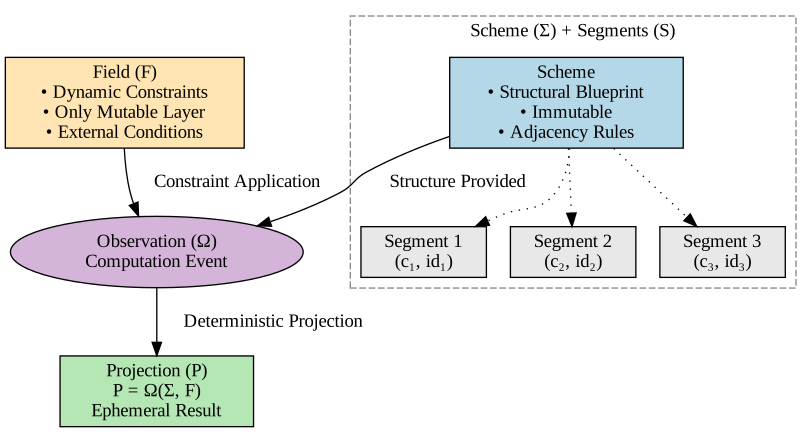
SSCCS comprises three ontologically distinct layers, each irreducible to the others [4]:
Formal Definition
The SSCCS observation model is formally expressed as:
\[P = \Omega(\Sigma, F)\]
where:
- \(\Sigma\): Immutable Scheme (Segment set and structural relationships)
- \(F\): Mutable Field (dynamic constraints)
- \(\Omega\): Observation operator (computation event)
- \(P\): Resulting Projection (computational output)
This formulation ensures that for identical \(\Sigma\) and \(F\), \(\Omega\) yields the same \(P\) under idealized conditions at the logical model level, providing deterministic reproducibility essential for safety-critical verification approaches [10]. Hardware validation will measure and characterize deviations due to physical effects (timing variations, temperature, memory contention).
Energy Model: Conceptual Framework
A simplified conceptual energy model for SSCCS [4]:
\[E_{total} = E_{observation} \times N_{obs} + E_{field-update} \times N_{update}\]
Note: This model focuses on logical operation costs. \(E_{observation}\) includes the cost of writing back the projection via the XIF result interface and implicit memory access costs for Segment/Field retrieval. The model emphasizes that Segments remain stationary during observation, reducing redundant data movement compared to von Neumann architectures where:
\[E_{vonNeumann} = E_{compute} + E_{memory-access} \times N_{access}\]
and \(E_{memory-access}\) often dominates at 60–80% of total energy [3]. Actual energy measurements will be obtained through hardware profiling.
Core Components
Segment: Atomic Coordinate Existence
A Segment is the minimal unit of potential—the fundamental building block of the SSCCS universe [4]:
\[s = (c, id)\]
where \(c \in \mathbb{R}^d\) (or discrete lattice) represents coordinates in a d-dimensional possibility space, and \(id = H(c)\) is a cryptographic hash providing unique identification.
Properties:
- Immutability: Once created, a Segment cannot be modified; it can only be referenced.
- Statelessness: Contains no values, strings, or data structures—only coordinates and identity.
- Concurrency: Any number of observations can occur simultaneously without synchronization at the logical model level.
Scheme: Structural Blueprint
A Scheme defines the geometric arrangement of Segments [4]:
- Dimensional axes: Specification of coordinate systems
- Internal structural constraints: Rules governing Segment relations
- Adjacency relations: Which Segments are neighbors in possibility space
- Memory layout semantics: How structural relations map to physical storage
- Observation rules: How observation resolves constraints into projections
Field: Dynamic Constraint Substrate
The Field \(F\) is the only mutable layer, but it does not store computational values [4]. Instead, it stores admissibility conditions that dynamically constrain which configurations of Segments are possible at any given time:
\[F = \{ \text{admissibility predicates over configuration space defined by } \Sigma \}\]
Mutating \(F\) changes which configurations are possible, but does not modify any Segment.
Observation and Projection
Observation \(\Omega\) is the single active event in SSCCS [4]:
\[P = \Omega(\Sigma, F)\]
Observation occurs when the structure and Field together create an instability—i.e., multiple admissible configurations. \(\Omega\) deterministically selects one configuration and returns it as \(P\). Segments remain stationary; the projection result is written back via XIF. Actual hardware behavior may exhibit variations due to physical implementation factors.
Compiler Pipeline and Structural Mapping
5-Stage Compilation Process
The SSCCS compiler transforms a high-level .ss schema into a hardware-specific layout through a deterministic pipeline [4]:

Pipeline Stages Detailed
| Stage | Input | Output | Key Operations |
|---|---|---|---|
| 1. Parsing & Validation | .ss text file |
Intermediate Representation (IR) | Schema parsing, cryptographic identity computation (SchemaId, SegmentId), structural validation |
| 2. Structural Analysis | IR | Relation graph | Adjacency/hierarchy/dependency extraction, independent subgraph detection, cycle detection |
| 3. Memory-Layout Resolution | Relation graph | Logical address map | Coordinate-to-address transformation, layout type application (RowMajor, ColumnMajor, SpaceFillingCurve) |
| 4. Hardware Mapping | Logical address map | Physical placement | Cache-line boundary consideration, bank interleaving, PIM capability utilization |
| 5. Observation Code Gen | Physical placement | Executable code/config | Native code emission, FPGA bitstream generation, observation operator implementation |
Unlike traditional compilers that produce instruction sequences, the SSCCS compiler produces geometric mappings: Scheme topology is partitioned across spatial coordinates with wire-length minimization as the primary cost function. This is graph partitioning, not instruction scheduling. Where Processing-In-Memory (PIM) reduces data movement distance, SSCCS eliminates data movement as a concept: data remains stationary at its scheme coordinate, and computation comprises only the constraint resolution across the topology.
Automated Optimization
Traditional manual optimizations become automatic consequences of structural specification in SSCCS [4]:
| Manual Optimization | SSCCS Mechanism |
|---|---|
| Data layout orchestration | Schema defines geometry; compiler maps to hardware |
| Cache alignment | Adjacency relations determine physical proximity |
| SIMD vectorization | Independent subgraphs imply vectorizable operations |
| Thread scheduling | Parallel structure maps to independent cores |
| Lock management | Immutability eliminates need for locks at logical model level |
| Execution strategy selection | Observation rules and structural independence guide parallel execution |
RISC‑V Ecosystem Integration Analysis
Alignment with RISC‑V Ecosystem
| Feature | RISC‑V Ecosystem (OpenHW CORE‑V) | SSCCS Value Add |
|---|---|---|
| Custom Instruction Support | CORE-V XIF enables tightly coupled coprocessors without modifying core RTL [5] | SSCCS implements observation instructions as custom XIF coprocessor extensions |
| Open-Source Verification | CORE-V-VERIF testbench uses RVVI methodology and Imperas reference models [6] | SSCCS provides structured execution model – observation results follow deterministic rules at the logical model level, potentially simplifying verification |
| Hardware Platform | CORE-V MCU DevKit (CV32E40P core + QuickLogic eFPGA) [7] | eFPGA allows rapid prototyping of SSCCS custom hardware accelerators alongside the core |
| Software Ecosystem | CORE-V SDK with GCC, FreeRTOS, and peripheral drivers [8] | SSCCS compiler can target the SDK, enabling integration of SSCCS-optimized libraries |
| Security & Safety | Members (Thales, NXP, Silicon Labs) emphasize functional safety and security [9] | SSCCS structured dataflow and immutability primitives can help reduce certain classes of vulnerabilities when properly integrated |
XIF Interface Architecture

XIF Signal Mapping
| XIF Signal | SSCCS Usage | Direction |
|---|---|---|
issue_valid |
Instruction ready for observation | Core → Coprocessor |
issue_ready |
Coprocessor ready to accept | Coprocessor → Core |
issue_opcode |
SSCCS custom opcode (custom1/custom2) |
Core → Coprocessor |
issue_rs1/rs2/rs3 |
Segment/Scheme identifiers | Core → Coprocessor |
commit_valid |
Observation complete | Coprocessor → Core |
result_data |
Projection output | Coprocessor → Core |
result_exception |
Observation error flag | Coprocessor → Core |
Observation Instruction Format
31        25 24    20 19    15 14    12 11       7 6         0
+----------+----------+----------+----------+----------+----------+
|  imm[11:0]  |   rs3    |   rs2    |   rs1    |  custom1 |  opcode  |
+----------+----------+----------+----------+----------+----------+
|<-------- R-type Format for OBSERVE instruction --------------->|
Opcode: custom1 (0x0B) or custom2 (0x2B) Function: OBSERVE rs1, rs2, rs3 → Load Scheme ID, Field ID, and Observation Rule
Structured Coprocessor Design
The SSCCS coprocessor implements a structured architecture to minimize side effects on core pipeline state [11]:
- The observation operator \(\Omega\) computes projections from stationary Segments following rules defined by the Scheme, without maintaining operational state between observations (all mutable state resides in the Field stored in main memory).
- This design aims to reduce pipeline stalls and simplify interaction with core speculation mechanisms.
- Direct write‑back through the XIF result interface ensures returned data follows standard pipeline forwarding paths, with careful coordination to avoid conflicts with core register‑file operations [12].
The ultimate hardware target for the Observation operator is a fabric where an Observation trigger causes simultaneous constraint-gate resolution across the coordinate space: no sequential instruction fetch, only signal propagation through the topology. The XIF coprocessor represents an intermediate step toward this architecture.
Research Roadmap
Phase 1: Software Emulation
Research Objective: Establish a working SSCCS software stack that can target RISC‑V cores, using OpenHW CORE‑V as a reference platform for simulation validation.
Methodology:
- Use riscvOVPsimCOREV (the Imperas reference simulator for OpenHW cores) [13] as a primary validation environment to develop and test SSCCS custom instructions
- Define a set of observation primitives (e.g.,
OBSERVE,COLLAPSE) as custom RISC-V instructions using the R-type format (opcode =custom1orcustom2) [14] - Implement an SSCCS runtime library that translates structural descriptions (
.ssfiles) into sequences of these custom instructions, ensuring compatibility with generic RISC‑V toolchains
This RISC‑V assembly emulation layer is a temporary scaffold—a concession to available instruction-set hardware. SSCCS’s native primitives are not instructions but constraints, Segments, Schemes, and Observations. The translation gap between structural specification and sequential assembly is bridged by compiler heuristics; a native structural fabric would dissolve this gap, collapsing observation directly into signal propagation.
Expected Outcomes:
- GitHub repository with SSCCS instruction set definitions and OpenHW CORE‑V integration examples
- Simulator-ready test suite for core operations (e.g., vector addition, matrix multiplication)
- Success Metric: Validate 5 core primitives with <1% simulation error vs. theoretical model on OpenHW CORE‑V, with documentation for extension to other RISC‑V implementations
Phase 1.5: Verification IP Integration
Research Objective: Integrate SSCCS extensions into the OpenHW CORE‑V‑VERIF verification environment as a reference implementation, ensuring compliance with RISC‑V extension verification standards.
Methodology:
- Develop UVM-compliant test sequences for SSCCS custom instructions within the CORE‑V‑VERIF framework [6]
- Create reference models comparing SSCCS observation results against Imperas simulation outputs [13]
- Document verification coverage metrics for custom instruction paths, producing guidelines applicable to other RISC‑V verification environments
Expected Outcomes:
- OpenHW CORE‑V‑VERIF extension module for SSCCS instructions
- Verification coverage report demonstrating compliance with RISC‑V extension verification methodology
- Success Metric: Achieve structural instruction coverage targets for SSCCS custom opcodes in UVM environment, with documented verification patterns reusable across the RISC‑V ecosystem. Note: Instruction coverage is a structural baseline; functional correctness requires additional behavioral testing.
Phase 2: XIF Coprocessor Prototype
Research Objective: Implement a functional SSCCS coprocessor using the RISC‑V eXtension Interface (XIF), with OpenHW CORE‑V as the primary validation platform.
Methodology:
- Design a XIF coprocessor module that receives custom instructions from the CV32E40P core via the issue interface, performs the observation, and returns results via the result interface [12]
- Support up to three source registers (
X_NUM_RS = 3) to accommodate complex structural operations [5] - Implement structured coprocessor architecture with no operational state to avoid side effects on core pipeline state [11]
- Use the commit interface to ensure deterministic execution without speculation [11]
- Implement direct write-back strategy through XIF result interface [12]
- Target the OpenHW CORE‑V MCU DevKit or a compatible FPGA platform (e.g., Nexys A7) for prototyping [7], with documentation for adaptation to other RISC‑V cores
Expected Outcomes:
- Verilog/VHDL implementation of the SSCCS coprocessor compatible with RISC‑V XIF specification
- Integration guide for RISC‑V users, with OpenHW‑specific examples
- Benchmark results comparing SSCCS vs. standard RISC-V implementations for key workloads
- Success Metric: Evaluate energy characteristics with a target of ≥3× reduction on vector addition vs. baseline RISC-V on OpenHW CORE‑V platform (to be validated and measured during the phase, with baseline methodology documented)
Phase 3: eFPGA Integration and MCU Validation
Research Objective: Demonstrate SSCCS running on RISC‑V MCU platforms, using the OpenHW CORE‑V MCU DevKit as a reference implementation.
Methodology:
- Map the observation logic into the QuickLogic ArticPro 2 eFPGA fabric integrated in the OpenHW CORE‑V MCU [7], [15]
- Use the APB interface from the CV32E40P core to configure the eFPGA with SSCCS accelerators dynamically [15]
- Develop a demonstration application (e.g., real-time sensor processing on the DevKit’s Himax camera) that uses SSCCS to evaluate energy and latency characteristics [16]
- Document the methodology for adapting SSCCS acceleration to other RISC‑V MCU platforms with eFPGA capabilities
The open-source silicon compiler ecosystem (SiliconCompiler, Yosys, OpenROAD, Chisel, CIRCT, FABulous eFPGA) provides the hardware target infrastructure that the SSCCS compiler pipeline will eventually target, making Phase 3 and beyond more feasible than they appear from a traditional ASIC development perspective.
Expected Outcomes:
- Open-source eFPGA bitstream and configuration code targeting OpenHW CORE‑V MCU
- Demonstration video and user guide showcasing SSCCS acceleration on RISC‑V
- Performance report quantifying data-movement reduction and verifiability characteristics, with comparative analysis against other RISC‑V MCU platforms
- Success Metric: Evaluate end-to-end latency on Himax camera pipeline with a target of <10ms and hypothesized ≥2× energy gain (to be validated on OpenHW CORE‑V MCU DevKit, with workload specifications documented)
Phase 4: Community Integration and Contribution
Research Objective: Upstream SSCCS components into OpenHW repositories as a reference implementation for the broader RISC‑V ecosystem.
Methodology:
- Contribute the SSCCS coprocessor design to the CORE‑V‑VERIF testbench as an example of custom extension verification [6]
- Explore proposing a new OpenHW Task Group focused on structural programming models, with cross‑ecosystem engagement
- Participate in OpenHW and broader RISC‑V community events (e.g., RISC‑V Summit, workshops) to gather feedback and attract contributors
Expected Outcomes:
- Pull requests submitted to OpenHW repositories, serving as a reference for other RISC‑V implementations
- Documentation and tutorials for OpenHW members and the wider RISC‑V community to replicate the SSCCS integration
- Success Metric: Submit ≥2 PRs to CORE‑V‑VERIF; engage ≥3 external contributors from the RISC‑V ecosystem. Note: Community adoption metrics will be tracked separately from contribution metrics.
Validation Domains and Expected Benefits
Target Application Domains
| Domain | Traditional Challenge | SSCCS Expected Advantage |
|---|---|---|
| Climate Modeling | Massive state space, grid data movement | Constraint isolation, structured observation, reduced redundant data transfer |
| AI/ML Inference | Memory bandwidth bottleneck for large models | Stationary weights, observation in place |
| Autonomous Systems | Sensor fusion, real-time decision making | Constraint-based observation, structured response, auditable decision traces at logical level |
| Scientific Computing | I/O energy and latency dominate runtime | Structural mapping aims to reduce redundant data movement |
| Graph Analytics | Pointer chasing causes cache thrashing | Structured parallel observation patterns |
| Cryptographic Systems | Side-channel attacks, verification complexity | Immutable structure enables formal verification approaches at logical model level |
Complexity Considerations
| Metric | Sequential | Parallel (SIMD/GPU) | SSCCS (Structural) |
|---|---|---|---|
| Instruction Overhead | High (O(N)) | Moderate (O(N/k)) | Field‑based primitives |
| Data Locality | Managed (Cache) | Explicit (SRAM/Tiling) | Scheme‑defined structure |
| Execution Latency | O(N) | O(N/k) + sync | Depends on Scheme structure and observation pattern (e.g., local grid observation: O(1); global pattern matching: O(N)) |
| Data Movement | O(N) | O(N) | Reduced through stationary data primitives (result write‑back still required) |
| Scalability Considerations | Amdahl’s Law | Memory Bandwidth | Physical constraints and structural complexity |
Note: The above complexity estimates are idealized and depend on specific Scheme definitions and observation patterns. Hardware validation will provide empirical measurements across representative workloads.
Benefits for RISC‑V Ecosystem (with OpenHW as Central Platform)
| Benefit | Description |
|---|---|
| Novel Programming Model | Adds “structural observation” to the RISC‑V software stack, with OpenHW CORE‑V serving as a reference implementation, differentiating open‑source RISC‑V cores from proprietary alternatives |
| Enhanced Verifiability | SSCCS’s structured execution model may simplify verification at the logical model level – a core concern for high-volume production SoCs [10]; OpenHW’s verification infrastructure provides a trusted validation baseline for the wider ecosystem |
| Energy Efficiency Exploration | SSCCS’s data‑movement reduction approach can be evaluated on OpenHW hardware, contributing evidence for energy‑conscious designs across the RISC‑V ecosystem [3] |
| Security Enhancement | Structured dataflow and immutability primitives can help reduce certain vulnerability classes (e.g., buffer overflows) when properly integrated. Observation operations at the coprocessor level exhibit deterministic behavior, potentially reducing certain speculative execution vulnerability classes. |
| Functional Safety Support | Observation structure enables traceability approaches for ISO 26262-compliant systems [9]; OpenHW’s safety‑oriented community accelerates adoption |
| Ecosystem Growth | Attracts researchers and developers interested in foundational computing paradigms to the RISC‑V community, with OpenHW as a central collaboration hub |
| Aligned with Member Interests | OpenHW members (e.g., NXP, Silicon Labs, Thales) emphasize security, safety, and efficiency – all central to SSCCS research [9]; these values resonate across the broader RISC‑V ecosystem |
Research Team and Resource Considerations
Research Team
This work will be led by Taeho Lee (Founder, SSCCS Foundation), with contributions from:
- Compiler Engineering: Backend development for
.ssto RISC-V translation, leveraging experience in LLVM and GCC toolchains - FPGA Architecture: XIF coprocessor implementation and eFPGA integration, with prior work on RISC-V acceleration
- Formal Verification: Academic advisors providing expertise in structured system verification
We anticipate collaboration with OpenHW members on technical tasks and co-authorship of deliverables.
Resource Considerations
| Resource Type | Description |
|---|---|
| Membership | OpenHW membership (e.g., Silver or Gold level) to access technical working groups and contribute to the roadmap [17] |
| Hardware Access | Access to CORE-V MCU DevKit and FPGA platforms (e.g., Nexys A7) for validation. SSCCS Foundation can cover shipping and handling costs |
| Technical Collaboration | Mentorship from OpenHW members experienced in XIF integration, eFPGA programming, and verification |
| Community Engagement | Opportunities to present SSCCS at OpenHW events and workshops (e.g., OpenHW TV, technical meetings) |
Risk Mitigation
| Risk | Mitigation Strategy |
|---|---|
| XIF interface complexity | Start with minimal instruction set (2–3 primitives); expand iteratively based on validation feedback [5] |
| eFPGA resource constraints | Prioritize observation logic over storage; leverage external DRAM for large Schemes [15] |
| Verification overhead | Leverage SSCCS’s structured model to potentially reduce test-case complexity; contribute test vectors back to CORE-V-VERIF [6] |
| Community adoption | Co-develop tutorials with OpenHW documentation team; host joint webinar post-Phase 2 |
| Model-to-hardware gap | Explicitly document assumptions and limitations of the logical model; validate deviations through empirical measurement |
Conclusion
Summary
SSCCS offers a unique opportunity to bring paradigm‑shifting research into the RISC‑V ecosystem, using the OpenHW Foundation as a central validation platform. By leveraging the OpenHW CORE‑V XIF interface and the CORE‑V MCU DevKit, we can explore how structural observation can complement conventional RISC‑V cores, with potential benefits for verifiability and energy efficiency. This collaboration aligns with OpenHW’s mission to drive innovation in open‑source hardware and provides a reference implementation for the broader RISC‑V community [18].
Limitations and Assumptions
This research report presents a conceptual framework and research pathway. Key assumptions include:
- The SSCCS logical model operates under idealized conditions; hardware implementations may exhibit variations due to physical constraints.
- Performance and energy claims are targets to be validated through empirical measurement, not guaranteed outcomes.
- Security benefits apply primarily at the coprocessor level for observation operations; system-level security requires comprehensive analysis.
- Verification simplification refers to structural coverage at the logical model level; functional correctness requires additional behavioral testing.
Long-Term Vision
Throughout all phases, the .ss blueprint remains unchanged, preserving investment [4]. The ultimate goal is to establish SSCCS as foundational infrastructure for sustainable, accountable computing—transitioning logic into a transparent, verifiable, and accessible Intellectual Public Commons.
Glossary
| Term | Definition |
|---|---|
| Segment | Immutable coordinate in possibility space; minimal unit of potential |
| Scheme | Structural blueprint defining Segment relationships and adjacency |
| Field | Mutable constraint substrate that governs what can be observed |
| Observation (Ω) | Active computation event that reveals Projection from Structure + Field |
| Projection | Ephemeral, deterministic output of an Observation at the logical model level |
| XIF | CORE-V eXtension Interface for tightly coupled coprocessors |
| CORE-V-VERIF | OpenHW verification framework using UVM and RVVI methodology |
| eFPGA | Embedded FPGA fabric for rapid hardware prototyping |
| PIM | Processing-In-Memory; computation within memory substrate |
| UVM | Universal Verification Methodology for hardware verification |
References
© 2026 SSCCS Foundation — Open-source computing systems initiative building a computing model, software compiler infrastructure, and open hardware architecture.
- Whitepaper: PDF / HTML DOI: 10.5281/zenodo.18759106 via CERN/Zenodo, indexed by OpenAIRE. Licensed under CC BY-NC-ND 4.0.
- Official repository: GitHub. Authenticated via GPG: BCCB196BADF50C99. Licensed under Apache 2.0.
- Governed by the Foundational Charter and Statute of the SSCCS Foundation (in formation).
- Provenance: Human-in-Command, AI-assisted. Aligns with ISO/IEC JTC 1/SC 42 and C2PA-certified. Full intellectual responsibility with author(s).