Space Computing: Radiation-Tolerant RISC‑V and SSCCS
SSCCS Field Composition Protocols for Adaptive, Semantic Fault Tolerance
This report explores a conceptual framework for a synergistic architecture combining SSCCS with radiation‑tolerant RISC‑V platforms for next‑generation space computing. While hardware‑level radiation hardening (e.g., StarRISC [1] [2], HARV‑SoC [3]) provides essential protection against single‑event effects, it suffers from static overhead and limited adaptability to evolving mission requirements. SSCCS introduces a software‑defined fault‑tolerance layer where Fields—executable, cryptographically signed binaries encoding constraint predicates and transition matrices—can be composed, sandboxed, and updated post‑deployment. By treating fault‑tolerance policies as dynamic Field binaries, this approach could enable: (1) adaptive redundancy via temporal/spatial voting strategies reconfigured via software, (2) semantic error detection through application‑level constraint validation beyond bit‑wise ECC, and (3) reduced SWaP through intelligent resource reuse. The report outlines a conceptual approach to architectural integration via OpenHW’s XIF interface and positions this synergy as a strategic response to ESA TRISTAN’s call for “deterministic, safe, and mixed‑criticality aware” space processors [4].
Introduction
Spaceborne and safety‑critical computing systems require high reliability under ionizing radiation. Recent years have seen the emergence of several radiation‑tolerant RISC‑V implementations, including StarRISC (StarRISC) [1], HARV‑SoC [3], and TMR‑protected RISC‑V processors [5]. These platforms employ techniques such as hardened flip‑flops, SECDED ECC, and Triple Modular Redundancy (TMR) to mitigate Single Event Upsets (SEUs). However, hardware hardening is static: once fabricated, the protection mechanism cannot adapt to new error patterns or mission phases, and it incurs significant area and power costs.
Concurrently, the SSCCS paradigm redefines computation not as instruction sequencing, but as the observation of stationary structures under dynamic constraints [6]. Central to this model is the Field, a mutable substrate that governs which states are admissible. Crucially, the SSCCS Whitepaper establishes that Fields are not merely abstract logic; they are first-class executable binaries that can be encrypted, signed, and sandboxed [6].
This report explores how the binary nature of SSCCS Fields could offer a unique solution to the rigidity of traditional Radiation Hardening by Design (RHBD). By loading “Fault Tolerance Fields” onto a StarRISC-like platform, adaptive, software-defined resilience could be achieved—evolving with the mission environment while reducing hardware overhead and enhancing resilience against complex failure modes like Multi-Bit Upsets (MBUs) and semantic corruption.
Terminology Clarification: This report distinguishes between:
- Radiation-Hardened (RH): Full tolerance to extreme environments (deep space, >100 krad, LET > 80 MeV·cm²/mg)
- Radiation-Tolerant (RT): Mitigation for Low Earth Orbit (LEO) and cubesat environments (<50 krad, LET < 40 MeV·cm²/mg)
StarRISC targets the RT regime; SSCCS Fields provide complementary semantic protection applicable to both regimes.
Radiation‑Tolerant RISC‑V Platforms: Capabilities and Limitations
StarRISC
StarRISC is based on the OpenHW CV32E40P core, fabricated in 22‑nm FD‑SOI technology. Key features include:
| Feature | Description |
|---|---|
| Hardened Sequential Elements | Stacked‑transistor flip‑flops resistant to SEUs up to LET ≈ 96 MeV·cm²/mg |
| ECC Protected Memory | SECDED (Single Error Correction, Double Error Detection) on 512 KB SRAM |
| Performance | Functional after 100 kRad (proton) TID; no SEFI observed in testing [1] |
| Power/Area | ~15% area overhead vs. baseline CV32E40P; 2.1 mW/MHz typical |
Residual Vulnerabilities:
- Multi-Bit Upsets (MBUs): SECDED ECC corrects single‑bit errors but fails against correlated MBUs in a single word or accumulated errors over time.
- Semantic Blindness: Hardware-level error detection operates on bits, not application semantics. A multi‑bit upset that results in a physically impossible state (e.g., velocity exceeding escape velocity) may go undetected.
- Static Protection: The hardening strategy is fixed at design time and cannot be adapted to changing mission requirements without pre‑designed overhead.
HARV‑SoC and TMR‑Protected RISC‑V
| Platform | Approach | Strengths | Limitations |
|---|---|---|---|
| HARV‑SoC [3] | Fault‑aware SoC with integrated error detection/correction | Proton irradiation characterization; on‑chip fault reporting | Relies on hardware‑based reporting; no dynamic reconfiguration |
| TMR‑Protected RISC‑V [5] | Triple Modular Redundancy + SRAM scrubbing | Effective against SEUs/MBUs; validated in high‑energy physics | 3× area/power overhead; protection level fixed at fabrication |
Common Limitations
All three platforms share two fundamental constraints:
- Hard‑coded Redundancy: Protection mechanisms are fixed in hardware, preventing adaptation to varying radiation environments or mission phases.
- Semantic Blindness: Hardware‑level error detection (ECC, voters) operates on bits, not on application‑level semantics. A multi‑bit upset that results in a physically impossible state may go undetected.
Landscape of Radiation‑Tolerant RISC‑V Research
Beyond the three platforms detailed above, the RISC‑V ecosystem has seen a surge of research targeting radiation tolerance. Below table summarizes key recent contributions with explicit SSCCS synergy opportunities.
| Study | Approach | Key Contribution | Synergy |
|---|---|---|---|
| StarRISC [1] | RHBD with hardened flip‑flops + SECDED ECC | Demonstrated functional operation after 100 kRad TID | Ideal target for Field sandboxing via PMP; minimal area overhead for Field accelerator |
| PIC64‑HPSC (Microchip/NASA) [[7]] | High‑performance RISC‑V with vector extensions | 8× SiFive X280 cores, Vector Extension, up to 2 TOPS AI/ML | SSCCS Fields for semantic validation of AI inference outputs in autonomous navigation |
| CORE‑V MCU (OpenHW) [[8]] | Ultra‑low‑power RT RISC‑V for cubesats | RV32IMC, PMP, SECDED ECC, 512KB SRAM | Reference platform for Field binary loading and XIF integration |
| On‑Demand Lockstep (Simões et al., 2024) [9] | Dynamic redundancy: cores operate in lockstep only when error rate exceeds threshold | Reduces power overhead by activating redundancy only during high‑radiation periods | SSCCS Fields can implement policy logic for mode switching decisions |
| MFID Decoder (Ghosh et al., 2025) [10] | Multi‑bit fault‑tolerant instruction decoder using parity + ECC | Protects against MBUs in instruction decode stage | Complements SSCCS semantic validation at application layer |
| TRISTAN Roadmap (ESA, 2025) [4] | European RISC‑V ecosystem strategy | Supply chain resilience, certification framework, mixed‑criticality requirements | SSCCS binary signing aligns with TRISTAN’s “trusted software stack” requirements |
Threat Model and Security Assumptions
Before detailing the SSCCS integration, this section defines the adversarial and environmental assumptions:
Radiation Environment Model
| Parameter | LEO/CubeSat Regime | Deep‑Space Regime |
|---|---|---|
| Total Ionizing Dose (TID) | 10–50 krad(Si) | 100–1000 krad(Si) |
| Linear Energy Transfer (LET) | < 40 MeV·cm²/mg | > 80 MeV·cm²/mg |
| Dominant Faults | SEU, occasional MBU | MBU, SEL, cumulative degradation |
Adversarial Capabilities
- Passive: Natural radiation causing SEUs/MBUs in logic, memory, or interconnect
- Active (theoretical): Fault injection via directed energy or compromised software updates
SSCCS Security Assumptions
- Root of Trust: Public verification key stored in OTP; immutable after fabrication
- Field Signing: All
.fieldbinaries signed with Ed25519 or ECDSA-P256; verification before execution - Memory Isolation: PMP enforces strict read/write/execute permissions for Field code, data, and Segment storage
- No Side‑Channel Leakage: Field execution time bounded; no data‑dependent branching in constraint predicates
The Core Enabler: SSCCS Fields as Executable Binaries
The synergy with StarRISC relies entirely on the properties of SSCCS Fields described in Section 2.3.3 of the SSCCS Whitepaper [6].
Dual Nature of Fields
In SSCCS, a Field \(F = (C, T)\) consists of a constraint predicate \(C\) and a transition matrix \(T\). While logically these define admissibility, physically:
| Property | Description |
|---|---|
| Executable Binaries | A Field is compiled into a platform-independent binary format (.field) containing bytecode for constraint evaluation and transition weighting |
| Cryptographic Integrity | Fields are digitally signed. This ensures that only authorized fault-tolerance policies (e.g., from Mission Control) are executed on the spacecraft, preventing malicious or corrupted updates |
| Sandboxing | Fields execute in isolated environments via PMP. A faulty or compromised Field cannot corrupt the underlying Segment data or other Fields, providing inherent structural isolation [6] |
Conceptual .field Binary Format
# Header structure for SSCCS Field binaries
field_header:
  magic: "SSCCS_FLD"          # 8B identifier
  version: uint16             # Format version (current: 0x0100)
  signature_alg: uint8        # Ed25519=1, ECDSA-P256=2
  constraint_type: uint8      # Dimensional=1, Algebraic=2, Semantic=3 [[@lee2026]]
  code_offset: uint32         # Byte offset to constraint bytecode section
  data_offset: uint32         # Byte offset to T-matrix/parameters section
  code_size: uint32           # Size of bytecode section (bytes)
  data_size: uint32           # Size of parameter section (bytes)
  timeout_cycles: uint16      # Max execution cycles for constraint eval
  signature: byte[64]         # Cryptographic signature over header+payload
Dynamic Composition
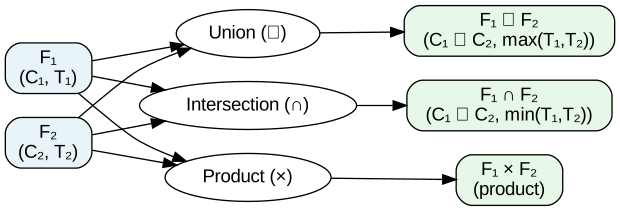
Fields support algebraic composition (Union, Intersection, Product) at the binary level [6]. This allows for runtime reconfiguration of fault tolerance strategies. For example:
| Mode | Field Configuration | Use Case |
|---|---|---|
| Normal Mode | Field_ECC_Light (minimal checking) |
Low-radiation environment; maximize performance |
| Solar Storm Mode | Field_ECC_Heavy ∩ Field_Temporal_Vote |
High-radiation period; strict temporal redundancy |
| Autonomous Nav Mode | Field_Semantic_Nav ∪ Field_Voting_Swarm |
Multi-spacecraft coordination with semantic validation |
This capability transforms fault tolerance from a hardware feature into a software-defined service.
Synergy: Software-Defined Radiation Hardening (SDRH)
As a hypothetical integration scenario, a hybrid architecture is conceivable in which StarRISC provides the physical baseline resilience, while SSCCS Fields could provide the adaptive, semantic resilience layer.
Temporal Redundancy via Observation Fields
Traditional TMR uses three physical cores. SSCCS enables Temporal TMR using a single core via the OBSERVE primitive. A “Stability Field” can be defined to require that a Segment’s value remains consistent across multiple observations within a time window.
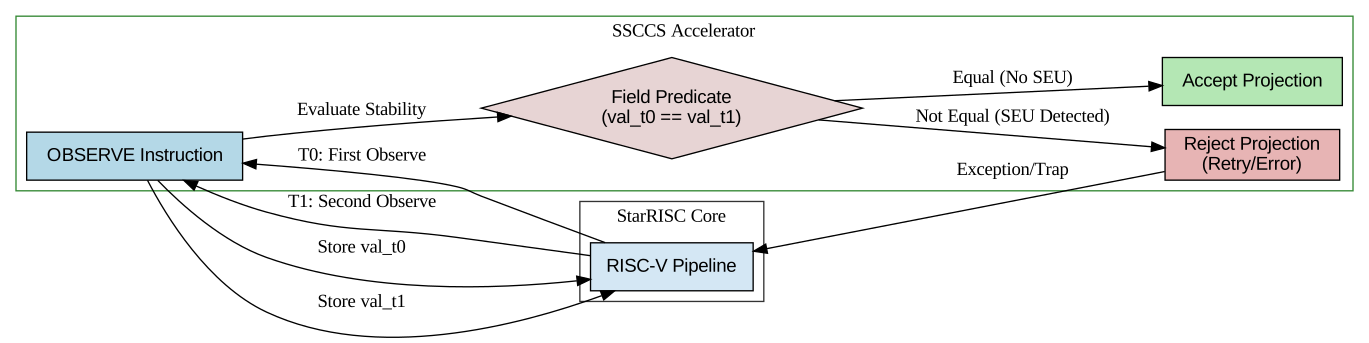
// Conceptual Rust-like pseudocode for a Stability Field
let stability_field = Field::new()
    .with_predicate(|segment| {
        let val_t0 = observe(segment);
        let val_t1 = observe(segment); // Re-observe
        val_t0 == val_t1 // Admissible only if stable
    })
    .with_timeout(50) // Max 50 cycles for evaluation
    .sign_with(mission_control_key);
Quantitative Analysis of Temporal Redundancy Overhead
The area overhead for SSCCS temporal redundancy is estimated at 8–12% relative to a baseline CV32E40P core, broken down as follows:
| Component | Resource Estimate | Area Contribution |
|---|---|---|
| Constraint Evaluation Unit (CEU) | ~500 LUTs (range checkers 200 + arithmetic 300) | ~3.1% |
| Transition Matrix Unit (TMU) | ~800 LUTs (4 multipliers + accumulator) | ~4.9% |
| Field Descriptor Table (FDT) | 1 KB SRAM | ~2.0% |
| Segment Cache | 2 KB SRAM | ~1.0% |
| Total | ~11% |
This is dramatically lower than the ~200% area penalty of full TMR.
SEU Detection Probability: With a single observation, the probability of an undetected SEU is \(p\) (the raw upset rate). With a Stability Field requiring two agreeing observations, the probability of an undetected SEU becomes \(p^2\) (assuming independent upsets). For example, if \(p = 10^{-6}\) per cycle, temporal redundancy reduces undetected upset probability to \(10^{-12}\) per dual‑observation window.
Latency Model:
- Best case (cache hit, simple constraint): 3–5 cycles
- Typical case (cache hit, moderate constraint): 8–12 cycles
- Worst case (memory fetch + semantic validation): 15–30 cycles
A configurable timeout_cycles field in the Field header prevents indefinite stalls.
Semantic Predictability Framework
Traditional fault tolerance operates at the bit level (ECC corrects flipped bits). SSCCS Fields operate at the semantic level (constraints validate physically admissible states). This enables a two‑tier defense:
Radiation Event → Hardware Layer → SSCCS Layer → System Response
SEU in register → ECC detects/corrects → Field predicate passes → Normal execution
MBU in memory  → ECC fails (valid codeword) → Semantic constraint fails → Safe fallback
Logic corruption → Voter disagreement → Temporal Field retry → Recovered state
Example: Navigation Coordinate Validation
// Semantic Field for spacecraft velocity constraint
let nav_field = Field::semantic()
    .with_constraint(|state: NavState| {
        // Physical law: |Δv| ≤ thrust_capacity × Δt
        let dv = state.velocity - state.prev_velocity;
        dv.magnitude() <= state.thrust_max * state.dt
    })
    .with_recovery(|state| {
        // Fallback: revert to last known-good state + alert
        state.revert_to_checkpoint();
        Alert::emit("Semantic violation detected");
    });
This approach directly addresses ESA’s concern about “non‑deterministic latency in mixed‑criticality systems” [4] by providing deterministic semantic validation independent of memory contention.
Distributed Voting with Signed Fields
In a multi-core or swarm configuration, SSCCS Fields enable Software-Defined Consensus. A “Voting Field” can be broadcast to multiple StarRISC nodes. Each node observes its local Segment and projects a value. The Field’s transition matrix \(T\) aggregates these projections using a majority vote or weighted average [6].
| Advantage | Description |
|---|---|
| No Hardware Voter | The voting logic is contained within the Field binary |
| Cryptographic Security | Since the Field is signed [6], a compromised node cannot inject a malicious voting algorithm |
| Adaptive Topology | Voting weights can be updated on-orbit to account for node degradation |
Architectural Implementation on OpenHW CORE-V
To explore the feasibility of this synergy, implementing SSCCS runtime support on the OpenHW CORE-V platform might be considered as a potential pathway, leveraging the eXtension Interface (XIF) [11].
Custom Instructions for Field Execution
Efficient execution of Field binaries would require hardware acceleration for the OBSERVE and COLLAPSE operations. Two custom instructions could be introduced via XIF:
| Instruction | Operation | Description |
|---|---|---|
OBSERVE rd, rs1, rs2 |
Project Segment | Reads Segment at rs1, applies Field at rs2, stores result in rd. Handles retry logic if configured |
COLLAPSE rd, rs1, rs2 |
Aggregate Projections | Combines multiple observations using the Field’s transition matrix \(T\) |
Instruction Encoding Details
Both instructions use the R‑type format within the RISC‑V custom‑0 opcode space. The encoding is as follows:
| Field | Bits | OBSERVE |
COLLAPSE |
|---|---|---|---|
| funct7 | [31:25] | 7'b0000001 |
7'b0000010 |
| rs2 | [24:20] | Field ID (index into FDT) | Field ID (index into FDT) |
| rs1 | [19:15] | Segment ID (base address) | Observation array base address |
| funct3 | [14:12] | 3'b000 |
3'b000 |
| rd | [11:7] | Destination register | Destination register |
| opcode | [6:0] | 7'b0001011 (custom‑0) |
7'b0001011 (custom‑0) |
// RTL signal definitions for XIF coprocessor
`define OPCODE_CUSTOM0   7'b0001011
`define FUNCT7_OBSERVE   7'b0000001
`define FUNCT7_COLLAPSE  7'b0000010
These instructions could allow the StarRISC core to offload the complex constraint evaluation of the Field to a tightly coupled coprocessor or accelerator, potentially minimizing performance overhead.
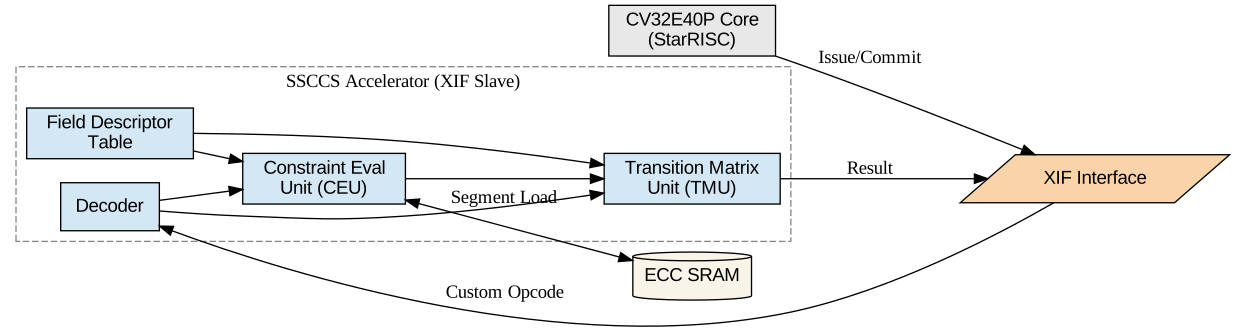
XIF Handshake Protocol for OBSERVE
| Stage | XIF Channel | Description |
|---|---|---|
| 1. Instruction Issue | Issue Interface | CPU asserts x_issue_valid; passes 32-bit instruction via x_issue_req.instr. SSCCS coprocessor accepts with x_issue_ready |
| 2. Register Read | Register Interface | Coprocessor asserts x_register_valid; requests source register addresses via x_register_req.rs. CPU returns values with x_register_resp.rdata |
| 3. Memory Access | Memory Request/Response | If OBSERVE needs Segment data, coprocessor issues load via x_mem_valid; receives data via x_mem_resp.rdata |
| 4. Result Return | Result Interface | After computation, coprocessor asserts x_result_valid; supplies x_result.rd and x_result.data. CPU accepts with x_result_ready |
| 5. Commit/Kill | Commit Interface | CPU asserts x_commit_valid upon instruction commit. If exception occurs, x_commit.commit_kill notifies coprocessor to abort |
XIF Handshake Timing Diagram
| Cycle | T0 | T1 | T2 | T3 | T4 | T5 | T6 |
|---|---|---|---|---|---|---|---|
x_issue_valid |
1 | 0 | 0 | 0 | 0 | 0 | 0 |
x_issue_ready |
1 | 0 | 0 | 0 | 0 | 0 | 0 |
x_register_valid |
0 | 1 | 0 | 0 | 0 | 0 | 0 |
x_register_ready |
0 | 1 | 0 | 0 | 0 | 0 | 0 |
x_mem_valid |
0 | 0 | 1 | 0 | 0 | 0 | 0 |
x_mem_ready |
0 | 0 | 1 | 0 | 0 | 0 | 0 |
x_result_valid |
0 | 0 | 0 | 1 | 0 | 0 | 0 |
x_result_ready |
0 | 0 | 0 | 1 | 0 | 0 | 0 |
x_commit_valid |
0 | 0 | 0 | 0 | 0 | 1 | 0 |
x_commit_kill |
0 | 0 | 0 | 0 | 0 | 1 (if exception) | 0 |
Secure Field Loading
Leveraging the Binary-Level Composition Protocols [6]:
- Upload: New Field binaries (e.g., updated fault tolerance policies) are uploaded to StarRISC’s secure memory.
- Verification: The SSCCS Runtime verifies the Ed25519/ECDSA signature of the Field binary against a root of trust stored in OTP.
- Sandboxing: The Field is loaded into a protected memory region (using PMP - Physical Memory Protection). It can only access Segments explicitly granted permission, preventing side-channel attacks or fault propagation [6].
Key Management for Long-Duration Missions
Space missions lasting years require the ability to update cryptographic keys post‑launch. The following key rolling mechanism is adopted:
- Initial Provisioning: OTP stores a single Master Public Key (immutable) programmed during fabrication.
- Key Update Procedure:
- Ground station generates a new key pair (PubKey₁, PrivKey₁).
- A special Key Update Field is created, containing the hash of PubKey₁ and signed by the Master Private Key (held securely on ground).
- The spacecraft receives and verifies the Key Update Field using the Master Public Key.
- Upon successful verification, the hash of PubKey₁ is written to a designated Key Segment in ECC‑protected SRAM.
- Field Verification with Updated Key:
- Subsequent Field binaries may be signed with PrivKey₁.
- The runtime verifies the Field signature using PubKey₁, validating the chain: Master → PubKey₁ → Field.
This approach maintains cryptographic agility while preserving the root of trust.

PMP-Based Memory Isolation Layout
Memory Map (StarRISC 512KB ECC SRAM):
| Address | Region | PMP Configuration |
|---|---|---|
| 0x0000_0000 | Trusted Runtime (TEE) | LOCK, R‑X |
| 0x0001_0000 | Field Code Section | LOCK, R‑X |
| 0x0002_0000 | Field Data Section | RW |
| 0x0003_0000 | Segment Storage | R (Field only) |
| 0x0004_0000 | Application Memory | RWX |
Conclusion
The conceptual integration of StarRISC and SSCCS suggests the potential for more than incremental improvement—it points toward a possible new design paradigm for resilient space computing. By exploiting the executable, composable nature of SSCCS Fields [6], this synergy transcends the limitations of static hardware hardening:
| Dimension | Traditional RHBD | SSCCS‑Enhanced Architecture |
|---|---|---|
| Adaptability | Fixed at fabrication | Post‑launch policy updates via signed Fields |
| Error Coverage | Bit‑wise (ECC, voters) | Semantic + bit‑wise (two‑tier defense) |
| Resource Efficiency | ~200% area for TMR | <10% overhead for temporal redundancy |
| Verification | Simulation + testing | Formal constraint validation + runtime monitoring |
| Supply Chain | Proprietary IP dependencies | Open-source (OpenHW + SSCCS); transparent auditability |
This synergy directly addresses the strategic imperatives identified by ESA TRISTAN: supply chain resilience through open standards, and deterministic execution for mixed‑criticality autonomy [4]. Furthermore, the cryptographic signing of Fields aligns with emerging space cybersecurity frameworks, providing a verifiable chain of trust from ground station to orbit.
A joint proof‑of‑concept with the OpenHW ecosystem could validate the XIF‑based SSCCS accelerator, potentially positioning this architecture as a reference implementation for next‑generation European and global space computing initiatives. The open‑source nature of both StarRISC and SSCCS would enable transparent verification—a critical differentiator for safety‑critical space missions.
Glossary
| Term | Definition |
|---|---|
| Segment | Immutable coordinate in possibility space; minimal unit of potential |
| Scheme | Structural blueprint defining Segment relationships and adjacency |
| Field | Mutable constraint substrate that governs what can be observed; executable binary in SSCCS |
| Observation (Ω) | Active computation event that reveals Projection from Structure + Field |
| Projection | Ephemeral, deterministic output of an Observation at the logical model level |
| XIF | CORE-V eXtension Interface for tightly coupled coprocessors |
| RHBD | Radiation Hardening by Design |
| RT | Radiation-Tolerant (mitigation for LEO/cubesat environments) |
| RH | Radiation-Hardened (full tolerance for deep-space environments) |
| SEU | Single Event Upset |
| MBU | Multi-Bit Upset |
| TMR | Triple Modular Redundancy |
| SECDED | Single Error Correction, Double Error Detection |
| PMP | Physical Memory Protection (RISC-V) |
| OTP | One-Time Programmable memory |
| SWaP | Size, Weight, and Power |
References
© 2026 SSCCS Foundation — Open-source computing systems initiative building a computing model, software compiler infrastructure, and open hardware architecture.
- Whitepaper: PDF / HTML DOI: 10.5281/zenodo.18759106 via CERN/Zenodo, indexed by OpenAIRE. Licensed under CC BY-NC-ND 4.0.
- Official repository: GitHub. Authenticated via GPG: BCCB196BADF50C99. Licensed under Apache 2.0.
- Governed by the Foundational Charter and Statute of the SSCCS Foundation (in formation).
- Provenance: Human-in-Command, AI-assisted. Aligns with ISO/IEC JTC 1/SC 42 and C2PA-certified. Full intellectual responsibility with author(s).
Technical Appendix
Microarchitecture of the OBSERVE Instruction
The OBSERVE rd, rs1, rs2 instruction applies the constraints \(C\) defined by the Field (rs2) to a Segment (rs1) to produce a projection. According to the SSCCS Whitepaper, “observation momentarily activates the Field, triggering a collapse of possibility and generating a projection” [6].
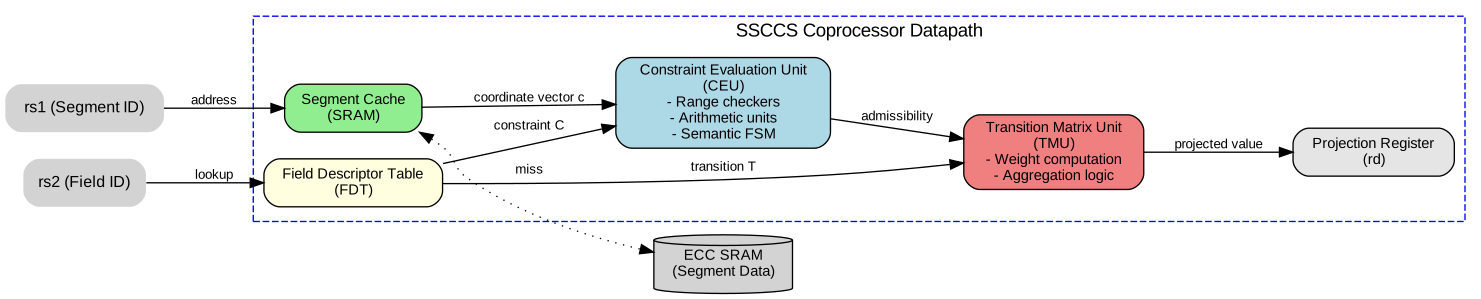
Key Hardware Blocks:
| Block | Estimated Overhead (RV32IMC) | Description |
|---|---|---|
| Segment Cache | ~2 KB; <1% area | Small SRAM storing coordinate vectors of frequently accessed Segments; coupled with StarRISC ECC |
| Constraint Evaluation Unit (CEU) | ~500 LUTs; ~3% area | Combinational logic evaluating Field’s constraint predicate \(C(s)\). Supports three classes [6]: (1) dimensional (range checks), (2) algebraic (linear inequalities), (3) semantic (finite-state validation) |
| Transition Matrix Unit (TMU) | ~800 LUTs; ~4% area | Computes Field’s transition matrix \(T(s, s')\). Accelerates max/min and multiplication operations [6] |
COLLAPSE Instruction Aggregation Mechanism
The COLLAPSE rd, rs1, rs2 instruction aggregates multiple observation results according to the Field’s transition matrix \(T\). In SSCCS theory, “collapse” refers to the process where “observation activates the Field, triggering a collapse of possibility and generating a projection” [6].
COLLAPSE is used in two primary scenarios:
| Scenario | Description |
|---|---|
| Temporal Aggregation | Aggregating multiple time-separated OBSERVE results of the same Segment to filter transient SEUs |
| Spatial Aggregation | Aggregating OBSERVE results from multiple nodes (cores) to implement distributed voting |
COLLAPSE Operation Pseudocode
Input:  rs1 = Base address of observation results array
        rs2 = Field ID (defines T matrix)
Output: rd = Final aggregated projection value

Algorithm (fixed-point arithmetic in Q16.16 format):
1. Load T(s, s') matrix from Field Descriptor Table.
2. for i in 0..N-1:
3.     proj_i = Memory[rs1 + i*4]  // Load observation (32-bit)
4.     weight_i = T(prev_state, proj_i)  // Q16.16 weight
5.     accumulated_weight += weight_i
6.     weighted_sum += proj_i * weight_i   // Q16.16 multiplication
7. if accumulated_weight == 0:
       rd = previous_projection   // fallback (tie)
   else:
       rd = weighted_sum / accumulated_weight  // weighted average
   or majority_vote(proj_0..proj_N-1)          // majority vote with tie → previous
Fixed-Point Arithmetic: All weights and intermediate sums are maintained in Q16.16 format to avoid floating-point unit overhead, suitable for resource‑constrained space processors.
Tie-Breaking Policy: In majority voting, if no candidate receives >50% of weighted votes, the system retains the previous projection value (conservative fallback).
This aggregation is implemented by reading observations from memory via XIF’s Memory Request/Response interface, computing weights in the TMU, and returning the result via the Result interface.
Hardware TMR vs. SSCCS Temporal Redundancy Comparison
| Comparison Item | Hardware TMR | SSCCS Temporal Redundancy |
|---|---|---|
| Redundancy Type | Spatial: 3 cores simultaneous | Temporal: Repeated observations on single core |
| Area Overhead | ~200% increase | ~8–12% (CEU+TMU+Field storage) |
| Power Overhead | ~200% increase | Additional consumption only during Field execution |
| SEU Detection Mechanism | Majority voter (combinational circuit) | Field stability predicate evaluation |
| MBU Coverage | Limited by voter granularity | Enhanced by semantic constraints |
| Adaptability | Fixed at design time | Dynamic (changeable by swapping Field binary) |
| Verification | Simulation + radiation testing | + Formal constraint validation |
Technical Compatibility Assessment
| Compatibility Element | Current Design Status | Feasibility | Recommendation |
|---|---|---|---|
| XIF-based OBSERVE/COLLAPSE | Defined at RTL encoding level | High | Future exploration might involve prototype development based on CV32E40PX + xif_copro [12] |
| CEU/TMU Hardware Units | Functionality specified in Whitepaper [6] | Medium | Detailed microarchitecture design per constraint type required |
| PMP-Based Sandboxing | Leverages standard RISC‑V feature | High | Optimization of Field-specific PMP context caching |
| Temporal Redundancy Mechanism | Defined at algorithmic level with quantitative estimates | High | Validation via SEU injection simulation |
| Cryptographic Signature Verification | Ed25519/ECDSA with key rolling | High | OTP public key storage required (exists on StarRISC) |
A three-phase validation roadmap (Simulation → FPGA Emulation → Radiation Testing) could provide an appropriate approach for systematically verifying these compatibility elements. In particular, the CV‑X‑IF compatible coprocessor example (xif_copro) [12] offers a reference template that could be adapted for SSCCS instruction implementation, potentially enabling use in Phase 2 FPGA emulation.