Other Formats
Rust Bare‑Metal Toolchain as a Foundation for RISC-V Integration
Leveraging Embedded Rust and Comprehensive Rust Bare‑Metal Guides for Structural Observation Primitives
Abstract
This research note examines the Rust embedded and bare‑metal programming ecosystems as documented in the Rust Embedded Book and Comprehensive Rust: Bare‑Metal, and maps their principles to the ongoing hardware‑integration research of the Schema–Segment Composition Computing System (SSCCS). SSCCS redefines computation as structural observation, requiring custom RISC‑V instructions and a deterministic, memory‑safe runtime. The Rust bare‑metal toolchain provides a unique foundation for implementing SSCCS observation primitives, offering zero‑cost abstractions, guaranteed memory safety, and seamless integration with RISC‑V targets. We compare the SSCCS hardware‑integration prototype against the patterns and recommendations of the Rust embedded guides, identifying alignment points, gaps, and opportunities for further research. The note concludes with a concrete roadmap for using Rust’s embedded ecosystem to accelerate SSCCS validation on OpenHW CORE‑V and other RISC‑V platforms.
Introduction
Motivation
The Rust programming language has emerged as a compelling choice for embedded and bare‑metal development due to its memory‑safety guarantees, zero‑cost abstractions, and expressive type system. Two canonical resources—the Rust Embedded Book [1] and the Comprehensive Rust: Bare‑Metal [2]—systematically present the patterns, tooling, and mindset required to write reliable firmware and low‑level software without a standard library.
Concurrently, the Schema–Segment Composition Computing System (SSCCS) proposes a paradigm shift from instruction‑sequence computing to structural observation, where computation emerges from the deterministic projection of immutable Segments within a dynamic Field [3]. Validating this model on real hardware—especially on open‑source RISC‑V cores—demands a software stack that can generate custom instructions, manage memory layouts without unnecessary data movement, and provide verifiable execution traces.
This research note asks: How can the Rust bare‑metal ecosystem accelerate the implementation and validation of SSCCS observation primitives on RISC‑V hardware? We examine the recommendations of the two Rust guides, compare them with the current SSCCS hardware‑integration prototype, and outline a concrete development pathway.
Scope
We focus on the following aspects of the Rust embedded guides:
- Toolchain setup – using
rustup, target specifications (riscv32imac‑unknown‑none‑elf), and thecargo‑generateworkflow. #![no_std]and allocation – working without the standard library, leveragingallocand custom heaps.- Peripheral access – the Peripheral Access Crate (PAC) pattern and the
embedded‑haltrait ecosystem. - Concurrency and interrupts – critical sections, interrupt handlers, and the
cortex‑m‑rt/riscv‑rtruntimes. - Debugging and profiling – using
probe‑rs,defmt, and semihosting.
We then map these topics to the SSCCS hardware‑integration research, which currently includes a custom‑instruction emulation library, a placeholder XIF coprocessor profile, and a test suite that runs on the RISC‑V target.
Summary of Rust Embedded and Bare‑Metal Guides
Rust Embedded Book
The Rust Embedded Book [1] is a community‑driven tutorial that walks through building embedded Rust applications step by step. Key lessons include:
- Cross‑compilation – adding a target with
rustup target addand using.cargo/config.tomlto set default flags. - Minimal runtime – the
cortex‑m‑rtcrate provides a startup sequence, vector table, and a#[entry]macro. - Memory‑mapped I/O – accessing registers via
volatileoperations or generated PACs. - Hardware abstraction layers – the
embedded‑haltraits (e.g.,OutputPin,Serial) enable portable driver code. - Concurrency – using
cortex‑m’sMutexandcritical‑sectionto share data between interrupts. - Debugging – integrating
defmtfor lightweight logging andprobe‑rsfor flashing and live debugging.
The book emphasizes a bottom‑up approach: start with a minimal no_std program, gradually introduce abstractions, and keep the hardware in view at all times.
Google’s Comprehensive Rust: Bare‑Metal Guide
The Comprehensive Rust bare‑metal guide (published by Google) [2] focuses on the fundamentals of running Rust without an operating system, covering:
- Boot process – the role of the linker script, the reset handler, and initializing
.data/.bss. - Global allocators – implementing a simple bump allocator to enable
alloccollections. - Exception handling – defining exception vectors and using the
#[exception]attribute. - Application processors vs. microcontrollers – differences between
cortex‑aandcortex‑mtargets. - Safety patterns – using
OwnedandBorrowedwrappers to enforce peripheral ownership.
Common Themes
Both resources underscore:
- Layered abstraction – from raw registers to type‑safe HALs.
- Compile‑time guarantees – Rust’s ownership and borrowing prevent data races and illegal memory access.
- Toolchain integration – seamless cooperation between
cargo,rustc, and vendor‑specific utilities. - Community‑driven crates – a rich ecosystem of
no_std‑compatible libraries (e.g.,heapless,embedded‑time).
These themes align directly with SSCCS’s need for a reliable, verifiable, and portable low‑level software stack.
Current SSCCS Hardware‑Integration Status
Prototype Overview
The hardware‑integration prototype has evolved into a dedicated Rust crate (baremetal_riscv/) that now contains five self‑contained assembly concepts, each with its own .S file, Rust extern "C" bindings, pure‑Rust fallback implementation, and golden‑anchor test harness:
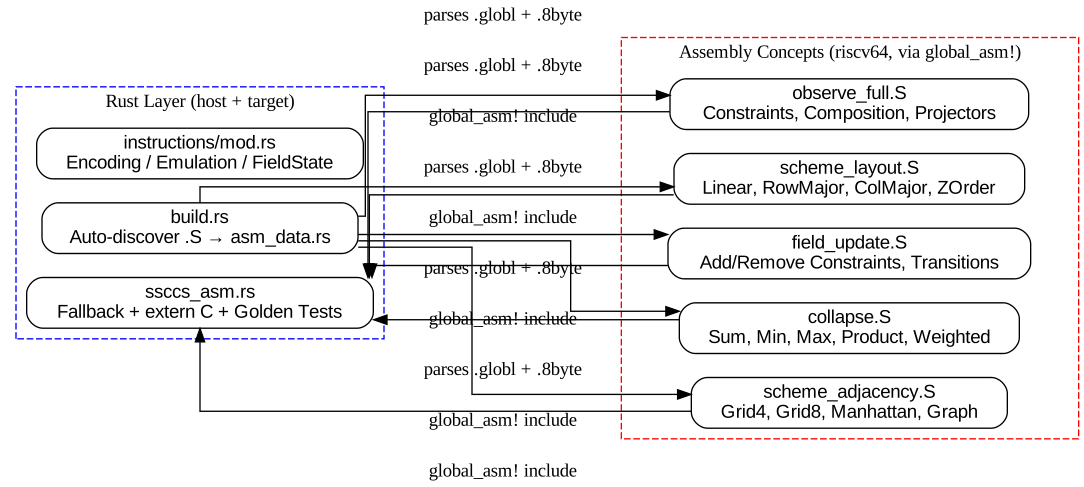
- observe_full.S (350+ lines) – Observation pipeline: branchless constraint primitives (
ck_even,ck_range,ck_eq_val,ck_gt), weighted field composition (compose_intersect,compose_union,compose_product_2d), semantic projectors (proj_id,proj_sum2d,proj_sum3d,proj_parity,proj_negate), and the observation pipeline (observe,observe_batch). - collapse.S – Multi‑segment reduction primitives:
collapse_sum,collapse_min,collapse_max,collapse_product,collapse_count, and weighted variants (collapse_weighted_sum,collapse_weighted_avg). - field_update.S – Field mutation:
field_add_constraint,field_remove_constraint,field_clear,field_add_transition,field_update_weight,field_get_transitions. - scheme_layout.S – Coordinate‑to‑address mapping:
layout_linear_1d,layout_linear_nd,layout_row_major_2d/3d,layout_col_major_2d,morton_encode_2d,layout_zorder_2d. - scheme_adjacency.S – Structural neighbor discovery:
adj_grid_4,adj_grid_8,adj_manhattan_1d,adj_graph_edges.
The crate’s build.rs automatically discovers all .S files under asm/, parses their .globl / .8byte directives, and generates a Rust module (asm_data.rs) with per‑file submodules containing the static segment data. This eliminates manual synchronization between assembly constants and Rust tests.
Alignment with Rust Embedded Practices
| Rust Embedded Guide Recommendation | SSCCS Prototype Status |
|---|---|
Use rustup target add to install the RISC‑V target |
Done (riscv32imac‑unknown‑none‑elf) |
Mark the crate as #![no_std] |
Done (#![no_std] in lib.rs) |
Provide a panic handler (e.g., panic‑halt) |
Done (panic‑halt dependency) |
Use a runtime crate (riscv‑rt) for startup |
Done (riscv‑rt dependency) |
| Define custom sections in linker script | Not yet – linker script default |
Implement embedded‑hal traits for portability |
Not yet – HAL traits not defined |
Use defmt or log for structured logging |
Not yet – logging uses println in host tests |
Leverage cargo‑generate for project templating |
Not yet – project created manually |
New: Modular assembly generation via build.rs |
Done – auto‑discovers .S files |
| New: Golden‑anchor cross‑validation | Done – GOLDEN_* comments in .S parsed by Rust tests |
| New: Pure‑Rust fallback for host testing | Done – all assembly functions have matching Rust fallbacks |
Gaps Identified
No custom linker script – The prototype relies on the default linker script provided by
riscv‑rt. For fine‑grained control over memory layout (e.g., placing Scheme segments in specific RAM regions), a custom linker script will be needed.Missing HAL abstraction – The
CoreVXifProfileis a concrete struct, not an implementation of anembedded‑haltrait. Adopting the HAL pattern would make the SSCCS coprocessor portable across different RISC‑V cores.Limited debugging infrastructure – The prototype uses
println!for host‑side tests but has no embedded‑side logging. Integratingdefmtwould enable lightweight, structured logging on real hardware.No cross‑arch assembly execution on CI – The assembly files are compiled via
global_asm!only onriscv64. The CI runs onx86_64, where only the pure‑Rust fallback is tested. A RISC‑V emulator (e.g.,spike,ripr) is needed to execute the actual assembly on CI.Rust‑to‑Assembly bridge – The Rust composition layer (
ComposedField,Projectortrait) has no automated path to produce the assembly that would run on hardware. Building this bridge is the next major milestone.
The Role of Assembly in the SSCCS Project
The assembly files serve a fundamentally different purpose from the machine code that Rust/LLVM generates:
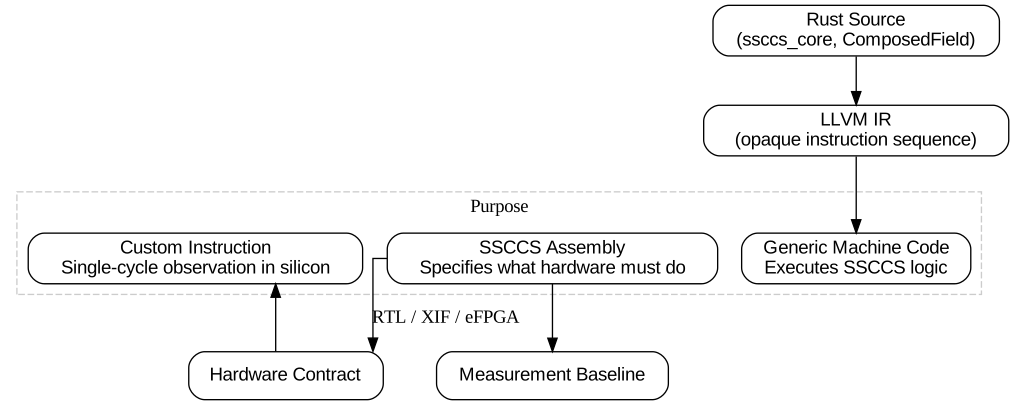
The assembly is not an alternative to LLVM – it is a hardware specification.
| Aspect | Rust/LLVM Output | SSCCS Assembly |
|---|---|---|
| Purpose | Executes SSCCS on a general‑purpose CPU | Specifies the minimal hardware interface |
| Consumed by | The CPU pipeline (decode, execute) | RTL designers, verification engineers |
| Verification | Tests pass on host (x86_64) |
Golden anchors cross‑validate .S ↔︎ Rust |
| Optimization target | Speed (LLVM passes) | Cycle count, energy per observation |
| Future use | Software simulation and prototyping | Direct hardware synthesis via XIF |
The assembly files prove that the SSCCS model does not implicitly depend on a complex runtime. The observe pipeline is ~20 instructions in the hot path, and the constraint primitives are 3‑4 branchless instructions each. This transparency is essential for:
- Hardware cost estimation – every instruction maps to a gate‑count estimate.
- Formal verification – the assembly can be fed to a formal equivalence checker.
- XIF coprocessor specification – the assembly is a functional reference for the custom‑instruction unit.
- Energy‑per‑observation measurement – cycle counts from the assembly provide a baseline that LLVM‑generated code cannot match because it must respect calling conventions and ABI overhead.
Connection to QiMeng Macro-Micro Paradigm
The SSCCS assembly layer gains deeper architectural legitimacy when viewed through the lens of the QiMeng multi-agent RISC-V automation system [4]. QiMeng has demonstrated that separating high-level strategy (“Macro Thinking”) from low-level implementation (“Micro Coding”) is critical for correct, optimized code generation:
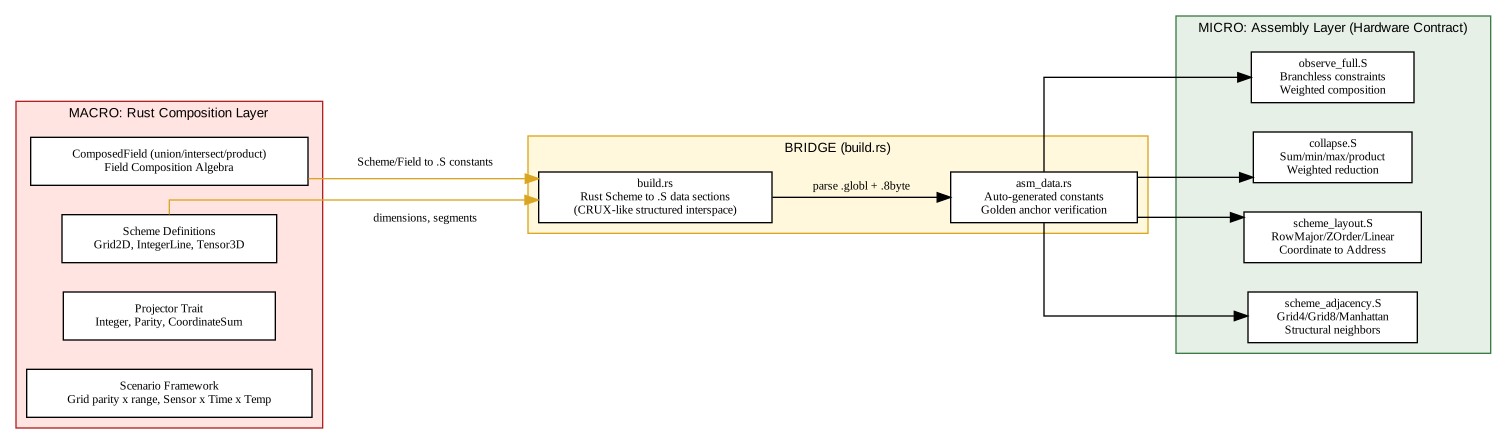
This macro-micro alignment connects the baremetal RISC-V prototype to the broader SSCCS neXus vision in three concrete ways:
Dual-Loop Validation: QiMeng’s internal functional correctness loop (simulation -> formal verification -> AST-level signal analysis) maps to our golden-anchor tests (
.S<-> Rust cross-validation). QiMeng’s external performance loop (benchmarks -> taped-out silicon -> Linux boot) maps to our future RISC-V emulation (spike/ripr) and OpenHW CORE-V hardware validation.CRUX-Style Structured Interspace: QiMeng-CRUX treats Verilog generation as constrained transformation through a formal intermediate representation. Our
build.rsserves the same architectural role: it parses the Rust Scheme/Field definitions and generates the structured.Sdata that bridges the macro (strategy) and micro (implementation) layers. Theasm_data.rsmodule is the structured interspace – generated constants that both layers must agree on.Self-Evolving Feedback: QiMeng-NeuComBack enables LLMs to improve IR-to-Assembly translation through iterative self-debugging. This pattern extends naturally to a future
build.rsthat evolves its assembly generation by comparing golden-anchor mismatches and adjusting the generation strategy – closing the loop between the Rust composition layer and the hardware contract layer.
Opportunities for Deeper Integration
Leveraging embedded‑hal for SSCCS Coprocessor Abstraction
The embedded‑hal trait set provides a common interface for hardware peripherals (GPIO, UART, SPI, etc.). We can define a new trait for SSCCS observation primitives:
pub trait ObservationCoprocessor {
    /// Issue an observation instruction, returning the projection.
    fn observe(&mut self, scheme_id: u32, field_id: u32, rule_id: u32) -> Result<u32, ObservationError>;

    /// Collapse multiple segments according to a mask.
    fn collapse(&mut self, scheme_id: u32, segment_mask: u32, field_id: u32) -> Result<u32, ObservationError>;

    /// Check whether the coprocessor is ready to accept a new observation.
    fn is_ready(&self) -> bool;
}
Concrete implementations could be:
SoftwareObservation– the current emulation fallback.XifObservation– a hardware driver for the OpenHW CORE‑V XIF interface.FpgaObservation– an accelerator mapped to an eFPGA fabric.
This design would allow SSCCS algorithms to be written once and deployed across simulation, FPGA, and ASIC targets.
Custom Linker Script for Scheme Memory Layout
SSCCS Schemes define a structural mapping from coordinate space to logical addresses. By writing a custom linker script, we can reserve memory regions for Scheme segments, Fields, and projection buffers, ensuring that the compiler’s layout decisions respect the spatial relationships implied by the Scheme.
Example linker script snippet:
MEMORY
{
    FLASH (rx) : ORIGIN = 0x00000000, LENGTH = 256K
    RAM (rwx)  : ORIGIN = 0x20000000, LENGTH = 64K
    SCHEME (r) : ORIGIN = 0x20010000, LENGTH = 32K   /* Reserved for Scheme segments */
    FIELD (rw) : ORIGIN = 0x20018000, LENGTH = 8K    /* Reserved for Field constraints */
}

SECTIONS
{
    .scheme_segments : {
        KEEP(*(.scheme_segments))
    } > SCHEME
}
The SSCCS compiler could then emit assembly that places segments into .scheme_segments, guaranteeing that adjacent coordinates reside in adjacent memory locations—a prerequisite for efficient observation.
Structured Logging with defmt
The defmt (“de‑format”) framework provides a lightweight, efficient logging mechanism that encodes log frames as integer indices, drastically reducing the bandwidth required for debugging. Integrating defmt into the hardware‑integration library would allow us to trace observation events, Field updates, and coprocessor state changes with minimal overhead.
use defmt::{info, warn, error};

impl ObservationCoprocessor for XifObservation {
    fn observe(&mut self, scheme_id: u32, field_id: u32, rule_id: u32) -> Result<u32, ObservationError> {
        info!("Observing scheme={:x}, field={:x}, rule={:x}", scheme_id, field_id, rule_id);
        // … hardware interaction
        let projection = …;
        info!("Projection result={:x}", projection);
        Ok(projection)
    }
}
Interrupt‑Driven Observation
In a real‑time system, observation requests may arrive from multiple sources (sensors, network packets, other cores). Using Rust’s critical‑section and cortex‑m (or riscv‑rt) interrupt facilities, we can design an observation queue that safely accepts requests from interrupt handlers and processes them in a low‑priority background loop.
This pattern aligns with the Concurrency chapter of the Embedded Book and would demonstrate how SSCCS’s immutability primitives simplify concurrent access (no locks needed at the logical level).
Roadmap: Next Steps Guided by Rust Embedded Practices
The current prototype has established the assembly layer and the Rust composition layer as independent systems. The roadmap now focuses on bridging them:
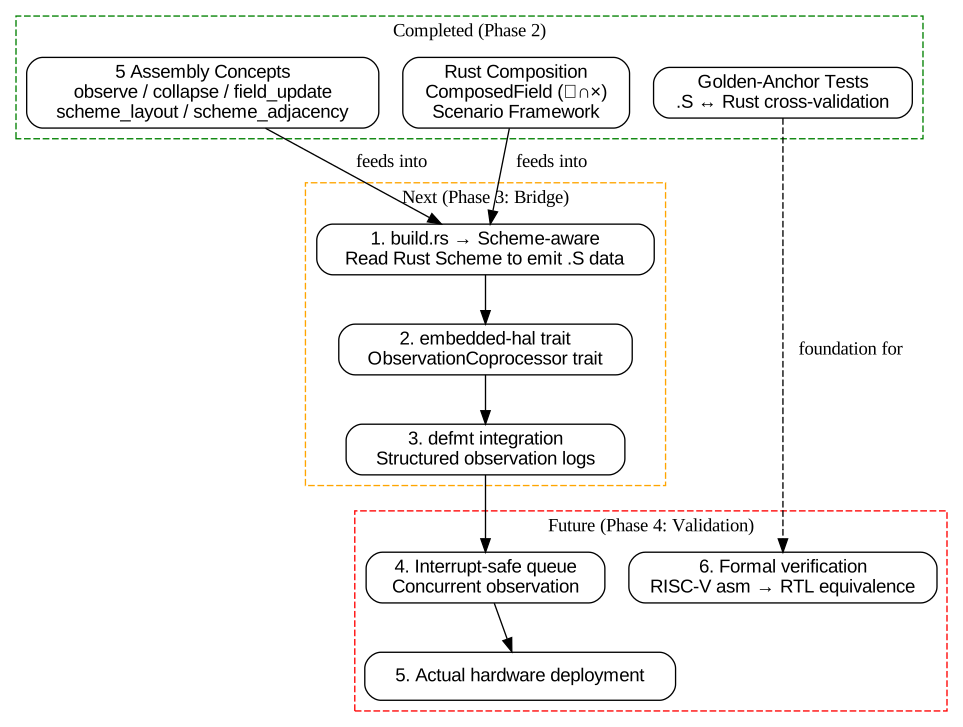
Based on the analysis above, we propose the following concrete actions:
Bridge: build.rs generates assembly from Rust Schemes (Month 1) – Extend
build.rsto read RustSchemedefinitions (e.g., Grid2D, IntegerLine) and generate the corresponding.Sdata sections automatically. This closes the gap between the composition layer and the hardware layer.Adopt
embedded‑haltrait design (Month 1) – RefactorCoreVXifProfileinto a trait and provide at least two implementations: a software emulator and a mock hardware driver.Integrate
defmt(Month 2) – Adddefmtas a dependency, implement theFormattrait for SSCCS core types, and produce a simple demo that logs observation sequences.Set up
cargo‑generatetemplate (Month 2) – Package the hardware‑integration workspace as a template so that new team members (or external contributors) can spin up a SSCCS‑hardware project with one command.Implement interrupt‑safe observation queue (Month 3) – Using
riscv‑rt’s interrupt macros andcritical‑section, build a concurrent observation scheduler that can be tested in simulation.Port to OpenHW CORE‑V MCU DevKit (Month 4) – With the abstractions in place, target the actual CORE‑V MCU hardware, using the
corev‑paccrate (if available) or hand‑written register definitions.Formal proof: assembly ↔︎ RTL equivalence (Month 5) – Feed the assembly files to a formal verification tool (e.g.,
riscv‑formal) to prove that a hardware observation unit matches the assembly specification.
Each step will be accompanied by a small example commit and a test that verifies the new capability, following the pedagogical style of the Rust Embedded Book.
Additional Considerations (Optional Enhancements)
RISC‑V‑Specific Register Access
The XIF interface may be configured via CSRs (Custom System Registers). The rust‑riscv crate provides a csr! macro that could be used to define and manipulate these registers safely. Incorporating this macro would align the SSCCS coprocessor driver with established RISC‑V bare‑metal practices.
High‑Level Hardware Description Languages
Beyond Verilog/VHDL, eFPGA integration could leverage modern HDLs such as Amaranth (Python‑based) or SpinalHDL (Scala‑based), which offer stronger type safety and better integration with software toolchains. These languages can generate FPGA bitstreams while remaining accessible to software engineers.
Memory Protection
SSCCS’s isolation properties could be reinforced by hardware memory protection. RISC‑V provides PMP (Physical Memory Protection) and, in higher‑end cores, MMU‑based virtual memory. While this is an advanced topic that may be omitted from the initial prototype, future safety‑critical deployments should consider integrating PMP regions to separate Scheme segments, Fields, and projection buffers.
Recommendations
This document presents a realistic and actionable research plan that accurately identifies points where the Rust embedded ecosystem can contribute concretely to SSCCS hardware integration. Notably, it avoids exaggerated promises (e.g., “hardware performance numbers”, “full ASIC implementation”) and honestly discloses current limitations.
Recommended actions:
- Proceed with the roadmap – implement the
embedded‑haltrait and custom linker script work as outlined. - Adopt
defmtearly – structured logging will greatly assist hardware debugging and should be attempted in the initial phases. - Secure OpenHW CORE‑V MCU DevKit access – obtaining the physical hardware early is crucial for validating the prototype on a real RISC‑V target.
- Prepare community contributions – based on this research, draft documentation (e.g., a guide to implementing custom instructions via XIF) that can be contributed to the OpenHW community.
Conclusion
The Rust embedded and bare‑metal guides provide a robust, community‑validated foundation for building low‑level software that is safe, portable, and maintainable. The SSCCS hardware‑integration prototype already follows many of their recommendations—no_std, a dedicated target, a panic handler, and a runtime crate—but several opportunities for deeper alignment remain.
By adopting the embedded‑hal trait pattern, custom linker scripts, defmt logging, and interrupt‑safe concurrency, the SSCCS research can leverage the full power of the Rust embedded ecosystem. This will accelerate the validation of structural observation on RISC‑V hardware, moving the SSCCS paradigm closer to real‑world deployment.
Ultimately, the combination of Rust’s guarantees and SSCCS’s structural model offers a promising path toward verifiable, energy‑efficient computing—a path that the Rust embedded community is uniquely equipped to help us walk.
Glossary
| Term | Definition |
|---|---|
no_std |
Rust crate that does not link the standard library, enabling bare‑metal and embedded targets. |
| PAC | Peripheral Access Crate – a machine‑generated set of register definitions for a specific microcontroller. |
| HAL | Hardware Abstraction Layer – a set of traits that define portable interfaces for hardware peripherals. |
defmt |
A lightweight logging framework for embedded Rust that encodes messages as indices. |
| Linker script | A file that directs the linker how to place sections in memory. |
| XIF | CORE‑V eXtension Interface – a RISC‑V interface for tightly coupled coprocessors. |
| Observation primitive | A basic SSCCS operation (e.g., OBSERVE, COLLAPSE) that can be realized as a custom instruction. |
| Golden anchor | A # GOLDEN_* comment in an assembly file that is parsed by a Rust test to verify cross‑layer consistency. |
| Hardware contract | An assembly‑language specification of the minimal interface that hardware must implement, used as a reference for RTL design. |
build.rs auto‑discovery |
The mechanism by which build.rs finds all .S files, parses their symbolic data, and generates matching Rust constants. |
References
[1]
Rust Embedded Working Group, The embedded rust book. 2026. Available: https://docs.rust-embedded.org/book/
[2]
Google, “Comprehensive rust: Bare-metal.” 2026. Available: https://google.github.io/comprehensive-rust/bare-metal.html
[3]
T. Lee, “Schema–segment composition computing system whitepaper.” DOI: 10.5281/zenodo.18759106, 2026.
[4]
S. Cheng et al., “Automated CPU design by learning from input-output examples,” in Proceedings of the 33rd international joint conference on artificial intelligence (IJCAI), 2024.
© 2026 SSCCS Foundation — Open-source computing systems initiative building a computing model, software compiler infrastructure, and open hardware architecture.
- Whitepaper: PDF / HTML DOI: 10.5281/zenodo.18759106 via CERN/Zenodo, indexed by OpenAIRE. Licensed under CC BY-NC-ND 4.0.
- Official repository: GitHub. Authenticated via GPG: BCCB196BADF50C99. Licensed under Apache 2.0.
- Governed by the Foundational Charter and Statute of the SSCCS Foundation (in formation).
- Provenance: Human-in-Command, AI-assisted. Aligns with ISO/IEC JTC 1/SC 42 and C2PA-certified. Full intellectual responsibility with author(s).