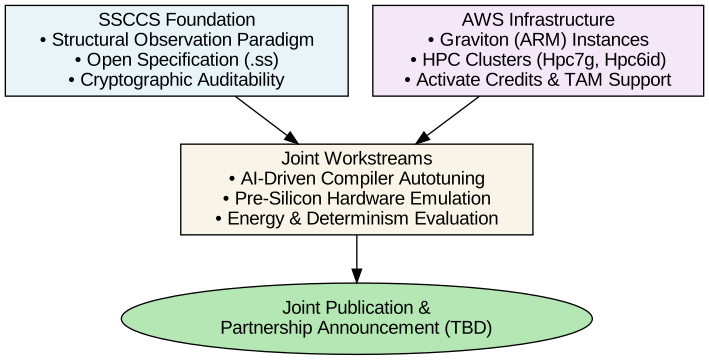
SSCCS × AWS Strategic Collaboration Roadmap
Self-evolving Autonomous Research & Validating System on AWS Infrastructure
Abstract
This document outlines a proposed collaboration between the SSCCS Foundation and AWS to validate SSCCS on Graviton and HPC infrastructure, focusing on AI-driven compiler optimization and pre-silicon hardware emulation. We believe AWS is well-suited to serve as a primary cloud platform for research into next-generation verifiable computing. The document will be updated in real time, as the collaboration develops.
Executive Summary
The SSCCS Foundation is advancing a novel computational paradigm that addresses the von Neumann “data movement wall” through structural observation rather than sequential instruction execution. To accelerate the research, validation, and deployment of this architecture, we also developing a project SSCCS Nexus: SSCCS’s proprietary knowledge infrastructure and autonomous research engine. Nexus integrates an engine-agnostic GraphRAG pipeline with a closed-loop agentic workflow (Hypothesis & Research Planning → Execution → Verification → Generation) and contract-governed artifact generation, transforming theoretical compiler and hardware research into reproducible, auditable, and continuously optimized outputs.
Specifically, we request AWS Activate credits and technical collaboration to execute two workstreams:
- AI‑Driven Autonomous Compiler Optimization on Graviton: Deploying agentic optimization systems on AWS Graviton instances to autonomously tune SSCCS compiler passes using cost models and liveness analysis.
- Hardware Emulation at Scale on AWS HPC: Utilizing AWS HPC clusters to simulate SSCCS behavior on future PIM/CIM architectures, and to evaluate energy efficiency and determinism before dedicated silicon becomes available.
SSCCS: The Computational Shift
The Von Neumann Bottleneck
For decades, mainstream computing has relied on the von Neumann model: sequential instruction execution, mutable state, and constant data movement between memory and processor. This architecture now faces well‑known barriers:
| Challenge | Impact |
|---|---|
| Data Movement Wall | 60–80% of energy spent moving data, not computing on it |
| Limited Concurrency | Explicit synchronization constrains parallel scaling |
| Lack of Verifiability | Black-box execution prevents auditable computation trails |
SSCCS: Observation, Not Execution
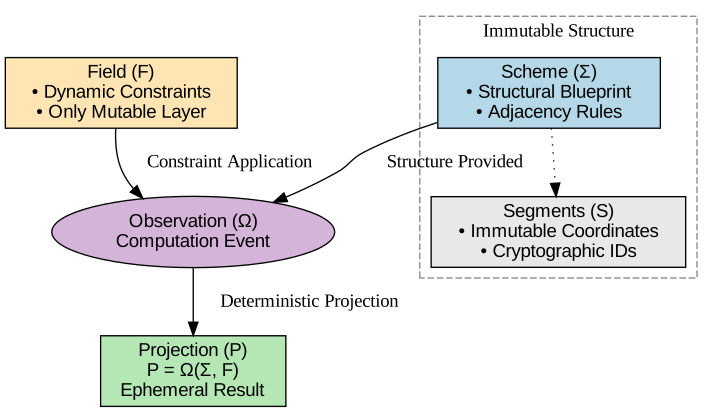
SSCCS redefines computation as the deterministic observation of immutable structures:
Formal Definition
The SSCCS observation model is expressed as:
\[P = \Omega(\Sigma, F)\]
where:
- \(\Sigma\): Immutable Scheme (Segment set and structural relationships)
- \(F\): Mutable Field (dynamic constraints)
- \(\Omega\): Observation operator (computation event)
- \(P\): Resulting Projection (computational output)
This formulation provides deterministic reproducibility for a given \(\Sigma\) and \(F\), which is important for verification in safety‑critical settings.
Energy Model
A simplified energy model for SSCCS:
\[E_{total} = E_{observation} \times N_{obs} + E_{field-update} \times N_{update}\]
Why AWS: A Suitable Validation Platform
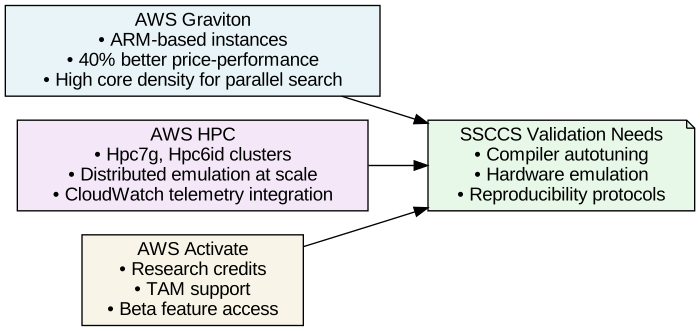
SSCCS requires significant computational resources to evaluate its hypotheses before dedicated hardware is available. AWS offers relevant capabilities:
| Requirement | AWS Capability | Relevance |
|---|---|---|
| Massively Parallel Compilation | Graviton’s price‑performance enables cost‑effective grid search over compiler configuration space | Allows testing SSCCS’s portability across ISAs, starting with ARM |
| Cross‑Architecture Validation | Diverse instance portfolio (Graviton, x86, HPC) | Assesses generality of SSCCS abstraction layers |
| Pre‑Silicon Emulation | HPC clusters provide scale to emulate PIM/CIM behaviour | De‑risks future hardware exploration |
| Reproducibility & Auditability | Consistent cloud infrastructure supports repeatable experiments | Aids research into computational auditability |
| Research Dissemination | Global reach and visibility | Helps share results with the wider community |
Strategic Workstream A: Autonomous Compiler Optimization on Graviton
The Challenge: Configuration Space Explosion
The SSCCS compiler must map high‑dimensional logical schemas to physical hardware topologies. This leads to a large configuration space:
| Parameter | Search Space | Impact |
|---|---|---|
| Fusion Aggressiveness (\(\alpha\)) | {0.2, 0.4, 0.6, 0.8, 1.0} | Controls operator fusion for latency reduction |
| Layout Strategy (\(\lambda\)) | {RowMajor, ColumnMajor, SpaceFillingCurve, Hierarchical} | Determines physical memory locality |
| Precision Mode (\(\pi\)) | {fp64, fp32, fp16, int8_mixed} | Balances numerical fidelity vs. energy/throughput |
| Liveness-Guided Allocation | Linear-scan buffer allocation | Aims to reduce peak memory by 30–48% through reuse |
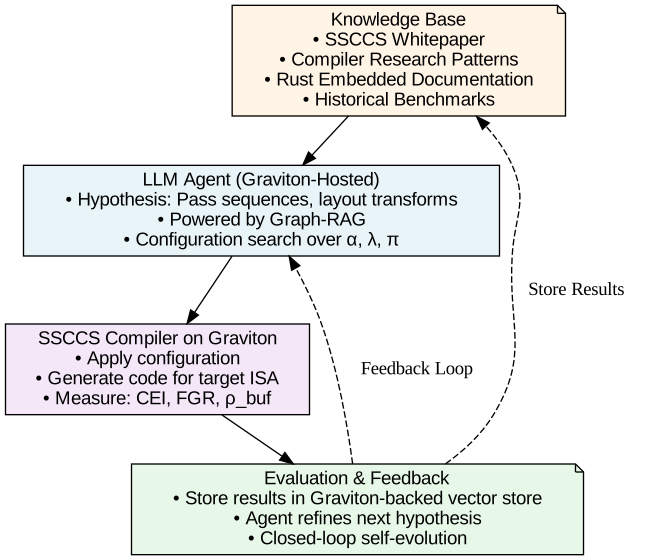
Manual tuning is impractical. We propose to develop an LLM‑driven autotuning agent and evaluate it primarily on AWS Graviton.
The Approach: Graviton-Based Agentic Loop
Workflow
- Hypothesis Generation: Agent proposes optimization pass sequences based on Schema structure.
- Automated Evaluation: Trigger parallel compilation jobs on Graviton clusters.
- Metric Collection: Measure CEI, FGR, latency, energy per configuration.
- Feedback Integration: Store results in Graph-RAG knowledge base for iterative improvement.
Key Metrics
| Metric | Formula | Purpose |
|---|---|---|
| Compilation Efficiency Index (CEI) | inference_speedup / compilation_time |
Quantifies return on compile‑time investment |
| Fusion Gain Ratio (FGR) | Estimated cost reduction from fusion passes | Diagnostic for fusion effectiveness |
| Buffer Reduction Ratio (\(\rho_{buf}\)) | Memory savings from liveness-guided reuse | Evaluates memory optimization impact |
Why Graviton?
| Factor | Rationale |
|---|---|
| Cost Efficiency | 40% better price‑performance vs. x86 allows large‑scale experiments within research budgets |
| Architecture Diversity | Testing on ARM provides a non‑x86 benchmark to evaluate portability |
| Scalability | High core density enables parallel search across many compiler instances |
| Alignment | Graviton instances align with energy‑efficient computing research, an area of interest to AWS |
Strategic Workstream B: Hardware Emulation at Scale on AWS HPC
The Challenge: Pre‑Silicon Validation - Without Dedicated Hardware Acceleration
SSCCS aims to achieve \(O(\log^ N)\) (Iterated Logarithm), \(O(\log \log N)\) or \(O(\log N)\) latency for operations that are \(O(N)\) in von Neumann systems. Evaluating this hypothesis requires simulating:
- Massive Segment Grids: Billions of immutable coordinates representing workloads such as climate models, protein structures, or graph analytics.
- Field Propagation: Constraint resolution across distributed memory nodes without explicit data movement.
- PIM/CIM Behaviour: Emulating processing‑in‑memory logic on standard DRAM hierarchies.
- Determinism Investigation: Assessing reproducibility of results (targeting coefficient of variation < 2.5%) across many parallel observations.

The Approach: AWS HPC Clusters
We seek access to AWS HPC instances (e.g., Hpc7g, Hpc6id) to:
- Distributed Emulation: Run the SSCCS runtime across many nodes, treating the cluster as a single structural manifold.
- Stress Testing: Examine the “stationary data” hypothesis under high concurrency, using AWS CloudWatch telemetry as energy proxy.
- Benchmarking: Generate comparative data against traditional HPC workloads (MPI/OpenMP) to quantify potential latency and energy improvements.
- Buffer Allocation Testing: Implement linear‑scan buffer allocators on simulated constrained‑memory environments (simulating NPU SRAM limits).
Value for AWS
| Benefit | Description |
|---|---|
| Research Showcase | Demonstrates AWS’s infrastructure supporting fundamental computing research. |
| Sustainability | If energy gains are confirmed, validations on AWS highlight the role of efficient cloud resources. |
| Community Engagement | May attract researchers interested in alternative architectures to the AWS ecosystem. |
| Long‑Term Insights | Results could inform future custom silicon considerations, though such outcomes are speculative at this stage. |
Proposed Collaboration Model: Exploring a Partnership
We envision a phased collaboration that could, upon mutual agreement, lead to a joint announcement acknowledging AWS’s role in this research.
Phase Deliverables
| Phase | SSCCS Plans | AWS Support Sought |
|---|---|---|
| Phase 1 | Functional autonomous optimizer; preliminary benchmark data; validated liveness analysis module | Cloud credits; Graviton/HPC access; technical onboarding |
| Phase 2 | Optimized SSCCS compiler stack with composable passes; joint technical publication: “AI‑Driven Compiler Design on AWS Graviton” | TAM support; beta feature access; architecture review sessions |
| Phase 3 | Potential joint announcement; open specification release; collaboration continuation | Co‑marketing and press support (if mutually agreed) |
Immediate Request & Next Steps
To explore this collaboration, we specifically request:
- Introduction to the AWS Activate Team: To discuss research credits for Graviton and HPC usage (non‑production).
- Technical Liaison: A short introductory call with an AWS solutions architect familiar with HPC workloads and Graviton‑based AI inference, to advise on optimal instance selection.
- Strategic Discussion: A conversation about potential collaboration pathways and how AWS’s involvement might be acknowledged in future publications.
We believe this work could be mutually beneficial, and we are eager to begin discussions. Our team has early prototypes; cloud‑scale infrastructure would significantly accelerate the research.
This document serves as the homepage for the SSCCS × AWS collaboration discussions. It will be updated to reflect:
- Progress on phases 1–3
- Joint technical publications and benchmark results
- Details of any joint announcements or consortium activities
- New validation domains and hardware targets