CVA6 CV-X-IF Exhaustive Verification Report
Deterministic encoding validation with ExaVerif (ev)
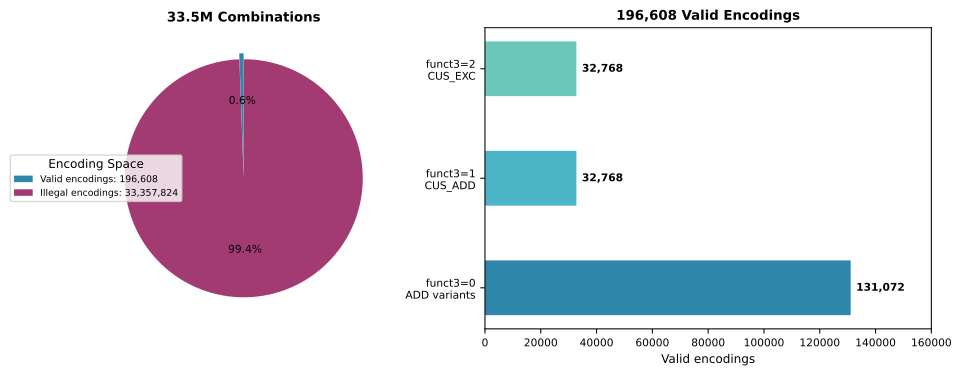
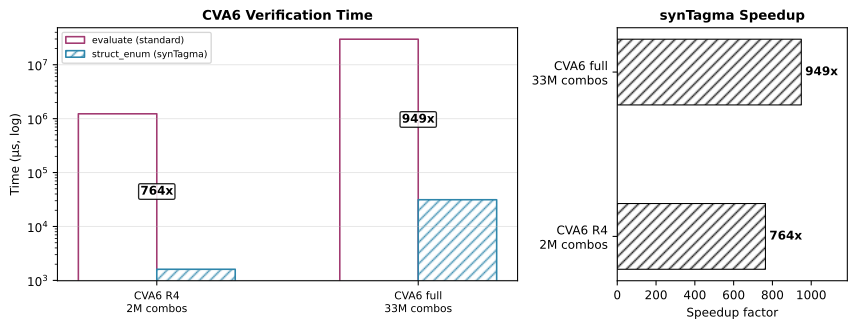
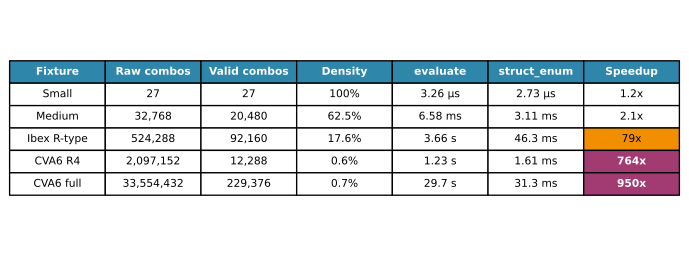
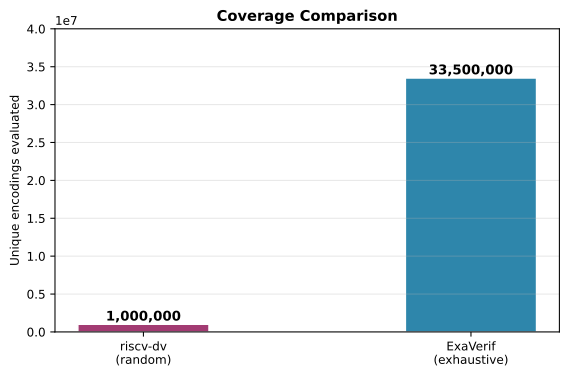
ExaVerif performed exhaustive verification of the RISC-V CVA6 core’s offloadable custom instruction encodings for the CV-X-IF coprocessor interface. The standard pipeline evaluates all 33,554,432 operand combinations in 29.7 seconds on a single ARMv8.4-A Firestorm system, yielding 229,376 valid encodings. The Tagma-based structural enumeration evaluates the same space in 31.3 milliseconds (structural_verify with all constraint checks) – a ~950x improvement – by generating only structurally valid combinations. At the CVA6 R4 fixture (2M combinations), struct_enum achieves 764x speedup (1.23 s vs 1.61 ms). Spike cross-validation confirms 100% correctness.
Verification Target
The CVA6 core (Ariane, OpenHW Group) offloads custom instructions to a coprocessor through the CV-X-IF interface whenever the core decoder encounters an illegal instruction. Four RISC-V custom opcode spaces (custom-0 through custom-3) are always illegal and therefore always offloadable. This verification covers the custom-3 opcode (0x7B) encoding space as defined by the CVA6 verification suite.
Six instructions are defined within this space, decoded by the coprocessor through a combination of the funct3 and funct7 fields:
| funct3 | funct7 | Instruction | Operand registers |
|---|---|---|---|
| 0 | 2, 6, 8, 32 | ADD variants | rs1, rs2 [, rs3] |
| 1 | 0 | CUS_ADD | rs1, rs2 |
| 2 | 96 | CUS_EXC | rs1 |
| 3..7 | any | illegal | — |
Exhaustive Verification Results
Speed and Scale
Structural Enumeration Performance
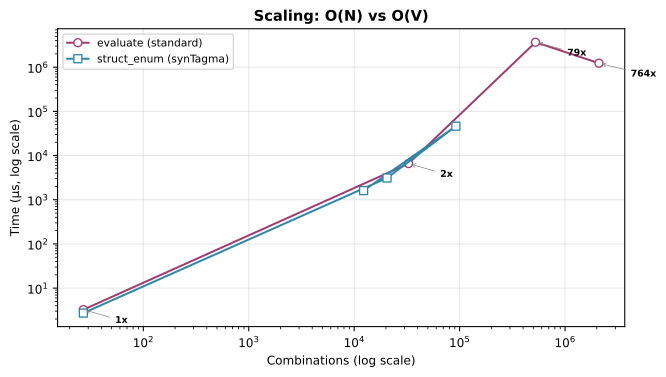
Scaling: O(N) vs O(V)
Benchmark Results (ARMv8.4-A Firestorm)
How It Works
A single YAML file describes the encoding space and its constraints. The entire space is enumerated exhaustively and evaluated deterministically — every point is classified as valid or invalid based on the specification.
ev verify --target cva6_xif_ref.xif.yamlEvery valid encoding can also be verified through actual RISC-V simulation. ExaVerif packs all 229,376 valid encodings into a single ELF binary and runs it under Spike + pk. All 229,376 pass.
EV_SIM_BACKEND=spike ev simulate --target cva6_xif_ref.xif.yamlStructural vs Standard: the mechanism
| Aspect | Standard (evaluate) |
Structural (struct_enum) |
|---|---|---|
| Combinations generated | All 33,554,432 | Valid only 229,376 |
| Constraint evaluation | 10 checks × 33.5M | 0 (structurally encoded) |
| Invalid detection | check.allows() → false |
Vacant slot → 1.65 ns |
| Memory | 4 GB peak (Vec) | 0 (lazy iterator) |
| Time (CVA6 R4) | 1.23 s | 1.61 ms |
| Time (CVA6 full) | 29.7 s | 31.3 ms |
Comparison with synTagma Benchmarks
The struct_enum speedup mirrors synTagma’s core thesis: structural addressing eliminates hash-based lookup overhead.
| synTagma primitive | ev application | Measured | Advantage |
|---|---|---|---|
| Nonexistent prefix lookup | Invalid encoding detection | 1.65 ns | 14.0Mx vs HashMap |
| CoordPath indexing | Combination addressing | 5.2 ns | O(depth) = O(5) |
| CoordSpace sparse get | Valid encoding iteration | 1.61 ms (2M space) | 764x vs evaluate |
| Axis projection | funct7/funct3 filtering | 46.3 ms (524K space) | 79x vs evaluate |
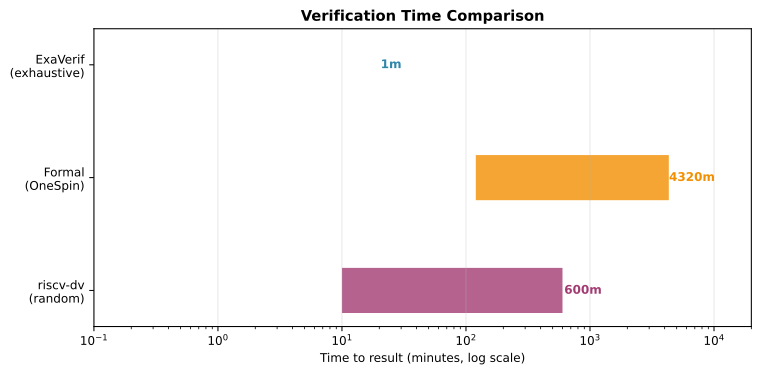
Comparison with Random Verification (riscv-dv)
Limitations
What ExaVerif does not yet model
- NOP instruction: CUS_NOP disables all register operands. A mechanism for conditional field activation is needed.
- func2 field: CUS_ADD_RS3 uses a dedicated func2 bit field, currently simplified into the funct7 domain.
- Weighted register distribution: CUS_EXC biases certain register values. ExaVerif treats all register values uniformly.
- Pipeline hazards: Write-after-read hazards (rs1==rd) are not modelled at the encoding level.