Chton
Materialization IO fabric for coordinate spaces over physical media
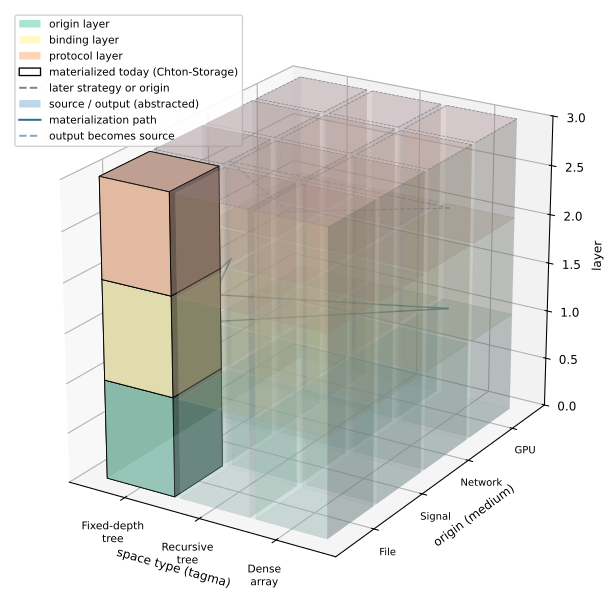
Chton is a matrix router and transformation implementations for the materialization(e.g. persistent IO) of the tagma coordinate space. The name chton comes from the Greek chthōn (earth): the layer every project stands on. The tagma specification defines the coordinate space as mathematical truth; tagma also carries the native infrastructure that embodies it, including the in-memory coordinate structures and the native key-value over them. chton lands that specification onto media outside memory: file, signal, network, and GPU origins, as byte-level bindings, per-space-type layout strategies, and materialization protocols. Memory is a projection surface, not a materialization target: an external medium projected into the address space is the mapped binding of that medium. The active use of the materialized space is the domain of systems that consume chton as infrastructure. The materialization surface is a fabric: any source is also an output, and any output is also a source, so the path matrix binds them one to one.
Layers
| Layer | Role |
|---|---|
| origin | byte-level bindings to media outside memory: file today; signal, network, and GPU media later. Memory is a projection surface, not a target |
| binding | per-space-type materialization strategies: fixed-depth tree today; recursive and dense layouts later |
| protocol | materialization protocols over origins: key-value first, sharing the tagma-kv CoordKV contract |
| io | flat key-space IO surface over materialized regions |
Design
- The storage format is the memory layout: there is no separate serialization step.
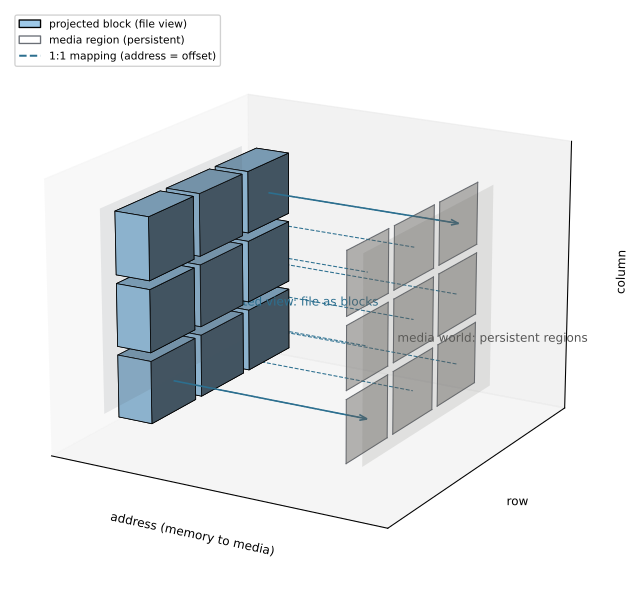
- Persistence is a 1:1 mapping of memory: a materialized block maps to a media region by address, so the block address is the region offset and reading and writing need no serialization step. A memory-mapped binding is the later mechanism for the same layout: the file projected into the address space is the mapped binding of that medium.
- The key-value protocol implements the tagma-kv CoordKV surface over origins. The native key-value lives in tagma as the in-memory form of the coordinate space; chton provides the same contract materialized onto file origins.
- Addressing is per-level array indexing: depth is bounded by file size, never by integer width.
- A protocol is origin-agnostic and an origin is protocol-agnostic. Storage is an attribute of the destination: a disk origin stores by nature, a signal origin propagates by nature. The same protocol materializes over either.
- Per-space-type strategies keep the materialization independent of the space type: the fixed-depth tree is the first strategy; recursive and other tagma space types are later strategies on the same surface.
Status
Early implementation. The origin, binding (tree strategy), and key-value protocol layers work over file origins, with memory as a projection surface. The key-value protocol currently exposes its own surface; implementing the tagma-kv CoordKV contract is the next step. Unit tests and a usage scenario run through ./run.sh. Memory-mapped persistence (mmap-style 1:1 media mapping), checkpoint and restore, and wave origins are later work.
Direction
The Chton brand covers the materialization families: Chton-Storage (disk and filesystem origins, the current role), Chton-Wave (signal origins, the tagma-wave materialization side), and Chton-Memory (time and snapshot materialization). The families share one surface: the materialization path matrix is the hub, and each family is a source that is also an output, so the fabric grows by adding paths, not by adding stacks.
Chton is a project of the SSCCS Foundation.